
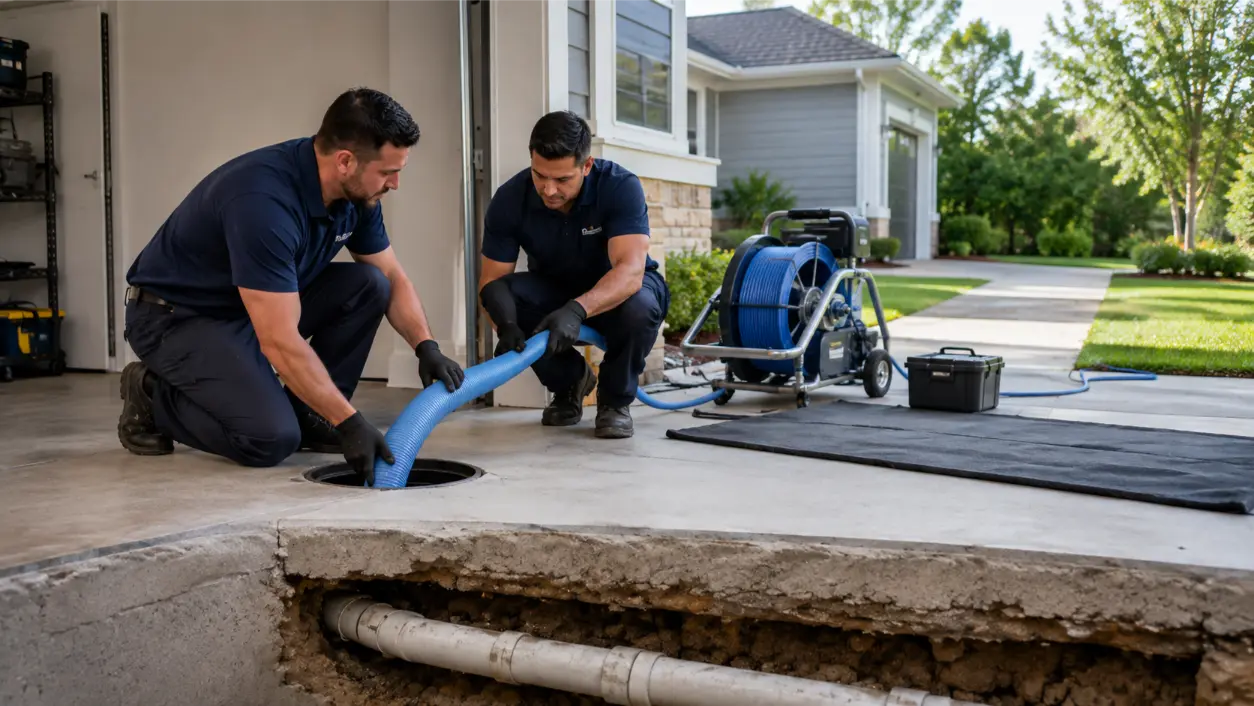
Sewer pipe repair under slab does not automatically mean jackhammering through a finished floor. In many homes and commercial properties, a damaged drain or sewer line beneath concrete may be a candidate for cured-in-place pipe lining, or CIPP, which rehabilitates the pipe from the inside through existing access points. The important word is candidate: whether the floor can stay intact depends on the pipe’s condition, alignment, access, diameter, branch connections, and the type of failure found during inspection.
For a property owner, the practical goal is not to choose “no-dig” repair before the diagnosis. It is to determine whether the existing pipe can serve as a reliable pathway and host for a liner. When it can, trenchless repair may avoid much of the demolition and reconstruction associated with opening a slab. When it cannot, a targeted excavation or conventional replacement may still be the safer, more durable option.
How a Sewer Pipe Ends Up Under a Concrete Slab
Many homes and buildings route sanitary drain piping below the slab before the line exits the structure and connects to the building sewer. That layout keeps piping out of living and working areas, but it also makes repairs more complicated when the pipe cracks, corrodes, separates, develops root intrusion farther downstream, or repeatedly catches debris.
Traditional access may require locating the failed section, moving furnishings or equipment, protecting the work area, cutting the floor, excavating soil beneath the slab, repairing or replacing the pipe, backfilling, patching concrete, and then restoring flooring or finishes. In a finished home, restaurant, office, retail space, or multifamily property, the plumbing repair may be only one part of the total disruption.
That is why trenchless pipe lining is especially relevant when the defective line runs beneath concrete.
What CIPP Pipe Lining Actually Does
Cured-in-place pipe lining rehabilitates an existing drain or sewer pipe by installing a resin-saturated liner inside it. Once positioned, the liner is pressed against the host pipe and cured, creating a continuous new pipe wall inside the existing route.
NuFlow’s NuDrain system, which Daniels Plumbing Services installs as a certified partner, is designed for non-pressurized systems such as sanitary drains, sewers, storm drains, and roof drains. NuFlow describes the system as capable of being installed from existing access points such as cleanouts, toilet risers, vents, and other available openings. That access-point approach is what can make pipe lining under concrete possible without opening the slab along the full pipe run.
CIPP is rehabilitation, not magic. The liner follows the pathway of the existing line. It can create a new structural interior through many cracks, fractures, holes, corroded areas, bends, and joints, but the existing pipe still determines where that new liner goes.
The Camera Inspection Is the Decision Point
Before anyone can responsibly say that an under-slab pipe can be lined, the line needs to be diagnosed. Daniels Plumbing’s published NuDrain process begins with camera inspection and cleaning. NuFlow likewise describes CCTV inspection as the first step in its lining process.
A camera inspection can help identify:
- Cracks, fractures, holes, corrosion, and deteriorated joints.
- Root intrusion or recurring buildup.
- Offsets between pipe sections.
- Sections that are flattened, badly deformed, or collapsed.
- Low areas where water remains in the pipe.
- Changes in pipe material or diameter.
- Branch connections, fittings, and access limitations.
- The approximate location and length of the defective section.
Sometimes the line must first be cleared or cleaned enough to get an accurate camera view. A clog by itself does not prove that the pipe needs structural rehabilitation, just as clearing a clog does not prove that the pipe underneath is sound.
Daniels Plumbing discusses this diagnosis-first approach in its article on multiple slow drains and main-line problems: restore flow when needed, then determine whether a recurring defect is present before choosing the long-term repair.
When an Under-Slab Sewer Pipe May Be a Good CIPP Candidate
The National Association of Sewer Service Companies explains that lateral CIPP is appropriate when an existing pipe has defects such as cracks, fractures, or holes but has generally maintained its original shape. For a residential or commercial under-slab line, that is a useful starting concept.
A lining candidate commonly needs:
- A continuous pathway through the pipe for inspection, cleaning, and liner placement.
- Enough remaining pipe shape to support the selected lining process.
- Access that allows the installer to prepare and place the liner properly.
- A defect that lining is designed to rehabilitate rather than a problem caused mainly by incorrect grade or configuration.
- A pipe interior that can be cleaned sufficiently for the selected system.
- A plan for active branch connections and termination points.
These conditions have to be confirmed on the actual property. The fact that a pipe is under concrete makes trenchless repair attractive, but it does not by itself make the pipe lineable.
When Breaking the Floor May Still Be Necessary
The most important limitation is that CIPP needs a workable host-pipe route. NASSCO notes that lateral lining is suited to pipe that has generally retained its shape. Its rehabilitation guidance also emphasizes that the existing line and grade remain after lining.
That means excavation or another repair method may still be required when:
- The pipe is fully collapsed or crushed. If there is no usable path for cleaning and liner insertion, a liner cannot simply pass through the obstruction.
- A severe offset blocks the pathway. Minor defects can be very different from a joint displacement that prevents equipment or liner placement.
- The pipe has a significant belly or bad grade. CIPP follows the existing alignment; it does not lift a sagging pipe or create a new slope beneath the slab.
- The pipe is missing or deformed beyond the selected system’s capability. Some gaps and deterioration can be rehabilitated, but the limits depend on the specific pipe, geometry, material, and lining design.
- Access is inadequate. Creating a small strategic access point may still be less disruptive than opening the entire floor, but the project is no longer completely access-free.
- The defect involves a condition better solved by replacement. Plumbing layout errors, repeated grade problems, incompatible connections, or changes to fixture layout may require physical reconstruction.
A trustworthy evaluation should be comfortable giving both answers: “This can be lined” when the evidence supports it, and “This section should be opened and replaced” when lining would not solve the actual problem.
What the Under-Slab CIPP Process Usually Involves
1. Map the symptoms and inspect the line
The plumber reviews recurring backups, slow drains, odors, prior repairs, fixture locations, and known cleanouts. A camera inspection is used to identify the defect and understand the route.
2. Clean and prepare the host pipe
Roots, scale, grease, corrosion, or other deposits may need to be removed with tools appropriate to the pipe and condition. Preparation matters because the liner must be installed into a clean, controlled pathway.
3. Measure and plan the liner
The repair section, diameter, fittings, branches, access points, and termination locations are mapped. A sectional repair may be possible in some cases; other systems may require a longer continuous liner.
4. Insert and cure the liner
For NuDrain, a resin-saturated flexible liner can be pushed or pulled into position through an existing access point. An internal bladder presses the liner into place while the resin cures according to the selected process.
5. Verify the finished repair
NuFlow’s published process includes a final CCTV inspection after curing. Verification matters because an under-slab repair should be documented before the line is returned to normal service.
Why Avoiding Slab Demolition Can Matter
Open-floor replacement may involve more than plumbing labor. Depending on the property, it can affect tile, hardwood, carpet, cabinetry, walls, commercial equipment, tenant access, dust containment, concrete matching, and business operations. Avoiding a long excavation path can reduce those secondary impacts when the pipe is suitable for lining.
That does not mean CIPP is always cheaper. Project cost depends on access, pipe diameter, cleaning, liner length, branch work, defect severity, finishes above the slab, and the alternative repair design. The correct comparison is the complete scope: plumbing work plus demolition, restoration, downtime, and any access work required by either method.
Ask for the proposed scope in writing so you can compare what each option includes rather than comparing only the first plumbing number.
Questions to Ask Before Approving Sewer Repair Under a Slab
- What did the camera inspection actually show? Ask to see the relevant section and understand the defect.
- Is the pipe still open and shaped well enough for lining? The installer should explain why the host pipe is or is not a good candidate.
- Is there a belly or grade problem? If so, ask whether lining would leave that condition unchanged.
- Which access point will be used? Confirm whether a cleanout, toilet riser, vent, or new access opening is part of the plan.
- How will the pipe be cleaned and prepared? Preparation should match the material and defect.
- How are branches and connections handled? Make sure active connections are identified before installation.
- Will there be a post-installation camera inspection? Ask how the finished work will be verified.
- What parts of the floor, if any, still need to be opened? “Trenchless” can mean minimal excavation rather than literally zero access work.
- What is included in the quote? Compare plumbing, access, cleanup, concrete repair, finish restoration, and downtime assumptions.
How Daniels Plumbing Services Approaches Under-Slab Pipe Repair
Daniels Plumbing Services provides residential and commercial plumbing service throughout Acworth, Marietta, Atlanta, and surrounding Georgia communities. Its services include drain and sewer work as well as NuFlow NuDrain CIPP pipe lining for qualifying drainage systems.
For a suspected sewer or drain failure beneath a slab, the useful first step is diagnosis. Daniels Plumbing’s NuDrain process uses camera inspection and cleaning before liner installation, helping determine whether the existing pipe can be rehabilitated internally or whether another repair method makes more sense.
Property owners can make an appointment with Daniels Plumbing Services to discuss recurring backups, known under-slab pipe damage, or a repair estimate. The final recommendation should depend on the actual pipe condition, access, geometry, material, and site constraints rather than on the desire to avoid demolition alone.
Frequently Asked Questions
Can you really repair a sewer pipe under concrete without digging?
In many cases, yes. CIPP lining can rehabilitate a suitable sewer or drain pipe from inside the existing route using available access points. However, fully collapsed, severely deformed, badly offset, or incorrectly graded sections may still require excavation or replacement.
Does pipe lining fix a belly in a sewer line?
No. CIPP follows the existing line and grade. If a low section is holding water because the pipe has settled or was installed with inadequate slope, lining does not physically raise that pipe. A plumber should determine whether the grade problem requires excavation and reconstruction.
Does the entire concrete floor have to be opened if one section cannot be lined?
Not necessarily. A project may use targeted access or combine conventional repair for one problem section with trenchless rehabilitation elsewhere. The practical objective is to open only what the confirmed defect and repair method require.
How do you know whether the pipe is lineable?
Camera inspection, cleaning, pipe measurements, material and diameter, access, deformation, branch connections, and the type of defect all influence the decision. The installer should explain the evidence supporting the proposed method.
Can CIPP be used for every pipe under a slab?
No. NuDrain is used for non-pressurized drainage applications such as sanitary drains and sewers, and every host pipe still has to be evaluated for suitability. Pressurized water-supply piping involves different products, standards, and design requirements.
Is trenchless repair always less expensive than breaking the slab?
No universal cost rule applies. Trenchless repair may reduce demolition and restoration work, but the final cost depends on the pipe condition, access, cleaning, liner design, length, branch connections, and the finishes or operations that conventional excavation would disturb.
This article provides general plumbing and construction information and is not a site-specific engineering, code, warranty, or repair recommendation. Sewer and drain conditions vary. Under-slab repairs should be evaluated by qualified plumbing professionals, and some projects may also require permits, engineering, utility coordination, or other specialized review.
RELATED LINK: NASSCO — Pipe Rehabilitation and CIPP Lateral Lining