
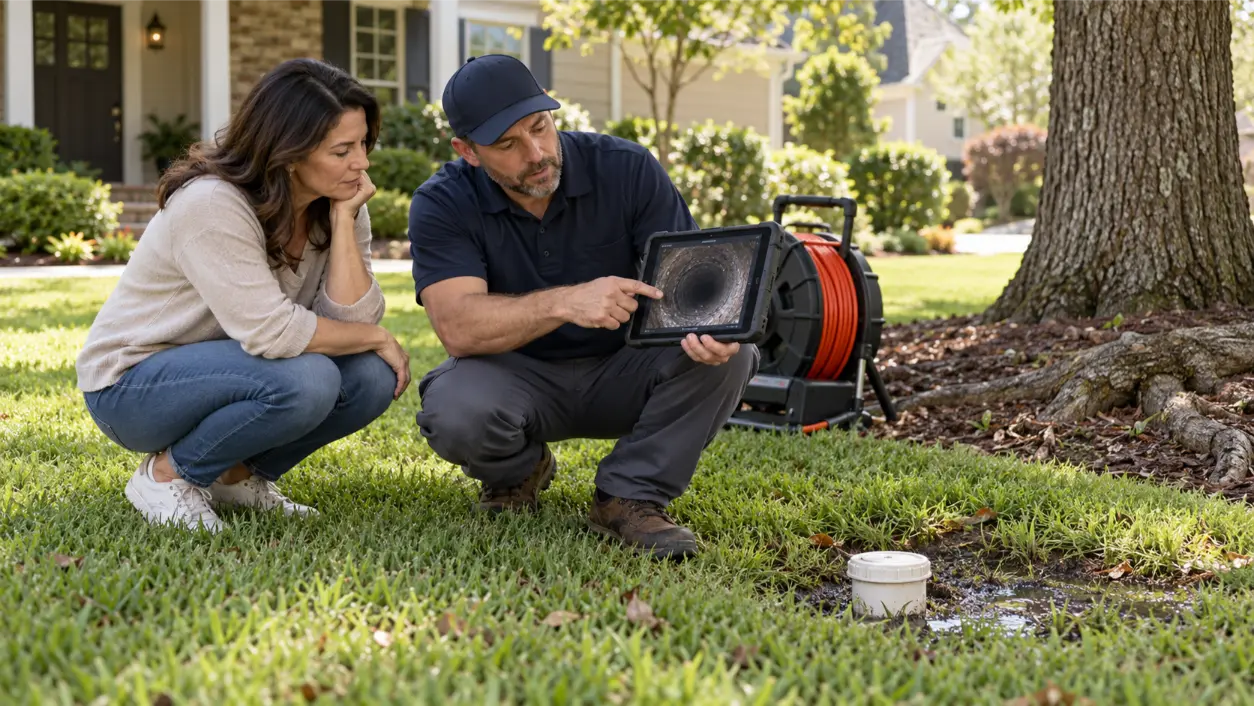
A cracked sewer line can stay underground and out of sight while the symptoms show up in very ordinary places: a drain that keeps backing up, a sewer odor that returns, or a patch of ground that stays wet when the rest of the yard is dry. The most useful signs of cracked sewer line damage are patterns, not one isolated clog. A single slow sink does not prove a broken sewer pipe, but repeated problems across the system can justify a closer look before the damage becomes more disruptive.
Why a Cracked Sewer Line Can Be Hard to Diagnose
A home’s main sewer line carries wastewater from multiple fixtures toward the public sewer or another approved disposal system. Because much of that piping is buried, homeowners usually cannot see a crack directly. Similar symptoms can also come from grease, wipes, root intrusion, scale, an offset joint, a sag, or a localized obstruction.
That is why the goal is not to diagnose a crack from the kitchen or the yard. The goal is to recognize when the pattern has moved beyond a normal single-fixture clog and deserves professional evaluation. A sewer camera inspection can help a plumber see roots, fractures, holes, joint problems, deformation, corrosion, and other defects that symptoms alone cannot identify.
Sign 1: The Same Sewer Backup Keeps Coming Back
One backup may be caused by a removable obstruction. A backup that returns soon after snaking or cleaning deserves more attention. If the line opens temporarily and then stops flowing again, something in the pipe may continue to catch waste or restrict flow.
Possible causes include root intrusion through cracks or joints, rough corroded pipe, displaced connections, a sag that holds debris, or structural damage that narrows the line. Seattle Public Utilities notes that roots can enter side sewers through vulnerable joints and defects, contribute to pipe damage, and cause backups.
The important question is whether the last service only restored flow or also investigated why the blockage formed. Daniel’s Plumbing Services makes the same distinction in its guide to recurring sewer backups: clearing the blockage and repairing the condition that keeps creating it are not always the same job.
Sign 2: Sewer Odors Return Indoors or Around the Yard
Persistent sewer odor can signal several plumbing problems, including a dry trap, venting issue, failed seal, or drainage problem. But when the odor repeatedly appears near a basement drain, crawlspace, cleanout, foundation edge, or the route of a buried sewer line, damage to the drainage system should be considered.
A crack, failed joint, or hole can allow wastewater or sewer gas to escape outside the intended pipe path. Odor alone cannot locate the defect, so avoid digging based on smell. Instead, note where and when the odor appears and whether it coincides with heavy water use, backups, or wet ground.
Sign 3: You Find Unexplained Wet, Soft, or Unusually Green Areas
A buried sewer leak may sometimes reveal itself as a damp patch, soft soil, localized settling, or an area of unusually vigorous plant growth over or near the sewer route. Those signs are not unique to sewer problems—irrigation leaks, stormwater, groundwater, and water-service leaks can create similar conditions—but they are worth investigating when they occur alongside drainage symptoms or sewer odor.
Avoid assuming that a greener patch proves sewage is leaking. The useful clue is the combination of location, persistence, weather conditions, and other plumbing symptoms. A plumber can compare the suspected area with the sewer path and use inspection equipment before recommending excavation.
Sign 4: Multiple Fixtures Become Slow or Start Gurgling
A slow bathroom sink by itself often points to a local fixture or branch drain. When toilets, tubs, showers, and sinks in different areas begin draining slowly at the same time—or one fixture gurgles when another is used—the restriction may be farther downstream in the main drain or sewer line.
Daniel’s Plumbing Services recommends treating a multi-fixture pattern differently from a simple sink clog. Depending on the symptoms, the next step may involve locating a cleanout, clearing the line, checking flow, or using a sewer camera to look for roots, buildup, breaks, offsets, or other physical defects.
This pattern still does not prove a crack. It tells you that the problem may be shared by multiple fixtures and that repeated chemical drain cleaners or isolated DIY work may not address the actual cause.
Sign 5: The Yard, Slab, or Foundation Area Starts Changing
More advanced underground leakage can sometimes affect the soil surrounding a damaged line. Warning signs may include a new depression in the yard, soft ground along the sewer route, erosion near a foundation, or unexplained moisture near a slab or crawlspace. These conditions can also have non-plumbing causes, so structural or drainage changes should be evaluated rather than attributed automatically to the sewer.
If the ground appears to be sinking, wastewater is surfacing, or a backup is entering the home, limit contact with contaminated water and contact qualified professionals promptly. The priority is to control the immediate condition and identify the source before choosing a repair.
What a Sewer Camera Inspection Can—and Cannot—Tell You
A camera inspection is valuable because it turns an underground problem into visible evidence. Current NuFlow guidance describes camera inspection as the first step in its NuDrain pipe-lining process, followed by measurement and cleaning so the pipe condition can be evaluated more accurately.
A camera may help identify cracks, holes, fractures, root intrusion, separated or offset joints, corrosion, deformation, standing water, and areas where the camera cannot pass. The plumber may also need cleaning, locating, measurements, or other diagnostic work before determining the severity of a defect.
Camera footage should guide the repair discussion rather than predetermine it. A visible defect may be suitable for localized repair, trenchless rehabilitation, or conventional replacement depending on its location, geometry, access, and the condition of the remaining host pipe.
Does a Cracked Sewer Line Always Need Excavation?
No. Some damaged sewer laterals can be rehabilitated without excavating the full pipe path. NASSCO describes cured-in-place pipe, or CIPP, as a trenchless method that can rehabilitate laterals with cracks, fractures, or holes when the host pipe has generally maintained its original shape.
Daniel’s Plumbing Services is a certified NuFlow partner and offers NuDrain CIPP for qualifying drain and sewer piping. The process installs a resin-saturated liner inside the existing pipe and cures it to form a new pipe within the host pipe. This can reduce disruption to floors, driveways, landscaping, or finished areas when the existing line is a suitable candidate.
But lining is not appropriate for every damaged pipe. A line that is badly collapsed, severely deformed, missing structural continuity, or otherwise unsuitable may require excavation, replacement, or another repair method. Inspection and cleaning should come before the repair recommendation.
A Homeowner Checklist Before You Call
- Write down which fixtures are affected and whether the problem is constant or intermittent.
- Note whether backups return after previous cleaning or snaking.
- Identify where sewer odor is strongest and whether it changes after heavy water use.
- Check the yard for new wet areas, soft ground, settling, or unusual growth.
- Look for a pattern across multiple drains rather than focusing on one fixture.
- Gather any previous sewer inspection, cleaning, or repair records.
- Avoid opening or excavating the sewer line yourself based only on symptoms.
- Ask the plumber whether camera inspection or other diagnostic work is appropriate before choosing a repair method.
When to Treat the Problem as Urgent
Call promptly when sewage is backing into the home, wastewater is surfacing outdoors, several fixtures have stopped draining, or the ground is actively sinking around a suspected sewer route. Avoid direct contact with sewage and keep children and pets away from affected areas.
If the symptoms are milder but recurring, schedule an evaluation before the next complete blockage. Repeated service calls often provide useful history: a line that needs increasingly frequent cleaning may be telling you that the underlying condition has changed.
How Daniel’s Plumbing Services Fits the Repair Decision
Daniel’s Plumbing Services serves Atlanta, Marietta, Acworth, and surrounding Georgia communities with drain cleaning, sewer and drain repair, service work, and specialty pipe lining. Homeowners dealing with recurring backups can review the company’s guide to recurring sewer backups, while owners of older cast-iron systems can read about CIPP repair for qualifying corroded cast-iron pipes.
As a certified NuFlow partner, Daniel’s Plumbing can also evaluate whether trenchless NuDrain CIPP may be appropriate after the sewer line has been inspected and its condition is understood. If you are seeing several of these warning signs, visit Daniel’s Plumbing Services to request service or discuss the next diagnostic step.
FAQ: Signs of a Cracked Sewer Line
Can a cracked sewer line still drain normally?
Yes. A crack or damaged joint may exist before the line becomes fully blocked. Some defects produce intermittent symptoms, root intrusion, leakage, or recurring clogs rather than an immediate total failure. A camera inspection may be needed to see the actual condition.
Does a sewer smell always mean the pipe is cracked?
No. Sewer odors can come from dry traps, venting problems, failed seals, backups, or other drainage issues. A repeating odor near the sewer route becomes more meaningful when it appears with wet ground, recurring backups, or other system-wide symptoms.
Can tree roots crack a sewer pipe?
Roots commonly exploit vulnerable joints, openings, and defects and can worsen sewer problems over time. Root intrusion can obstruct flow and contribute to backups. The condition of the pipe should be inspected before deciding whether cleaning, repair, or rehabilitation is appropriate.
How do plumbers find a broken underground sewer line?
Depending on the situation, plumbers may use symptom mapping, cleanouts, drain equipment, sewer cameras, locating equipment, cleaning, and measurements. The exact diagnostic sequence depends on access and what the line is doing.
Can a cracked sewer pipe be lined instead of replaced?
Sometimes. CIPP lining can rehabilitate certain cracked, fractured, or deteriorated pipes when the host pipe remains suitable for lining. Collapsed, badly deformed, or otherwise unsuitable sections may need replacement or a different repair method.
The Bottom Line
The most useful cracked sewer pipe symptoms are recurring patterns: backups that return, sewer odor that will not stay gone, unexplained wet ground, multiple slow drains, and changes in the yard or foundation area. None of those signs proves the pipe is cracked by itself.
Use the symptoms as a reason to investigate rather than a reason to guess. A professional inspection can show whether the problem is a removable blockage, root intrusion, corrosion, a damaged joint, a crack, a collapse, or another condition—and that evidence should determine whether the next step is cleaning, repair, trenchless lining, or replacement.
Disclaimer: This article provides general plumbing and property-maintenance information and is not a site-specific plumbing, structural, environmental, code, or repair recommendation. Sewer symptoms can have multiple causes, and repair suitability depends on pipe material, condition, geometry, access, soil, cleaning results, local requirements, and professional inspection. Avoid direct contact with sewage and consult qualified plumbing and other appropriate professionals for active backups, surfacing wastewater, structural changes, or suspected underground pipe damage.
Official Resources
- Seattle Public Utilities – Side Sewer Defects & Issues
- NASSCO – Pipe Rehabilitation
- NuFlow – NuDrain Cured-In-Place Pipe Lining
RELATED LINK: NASSCO – Pipe Rehabilitation