
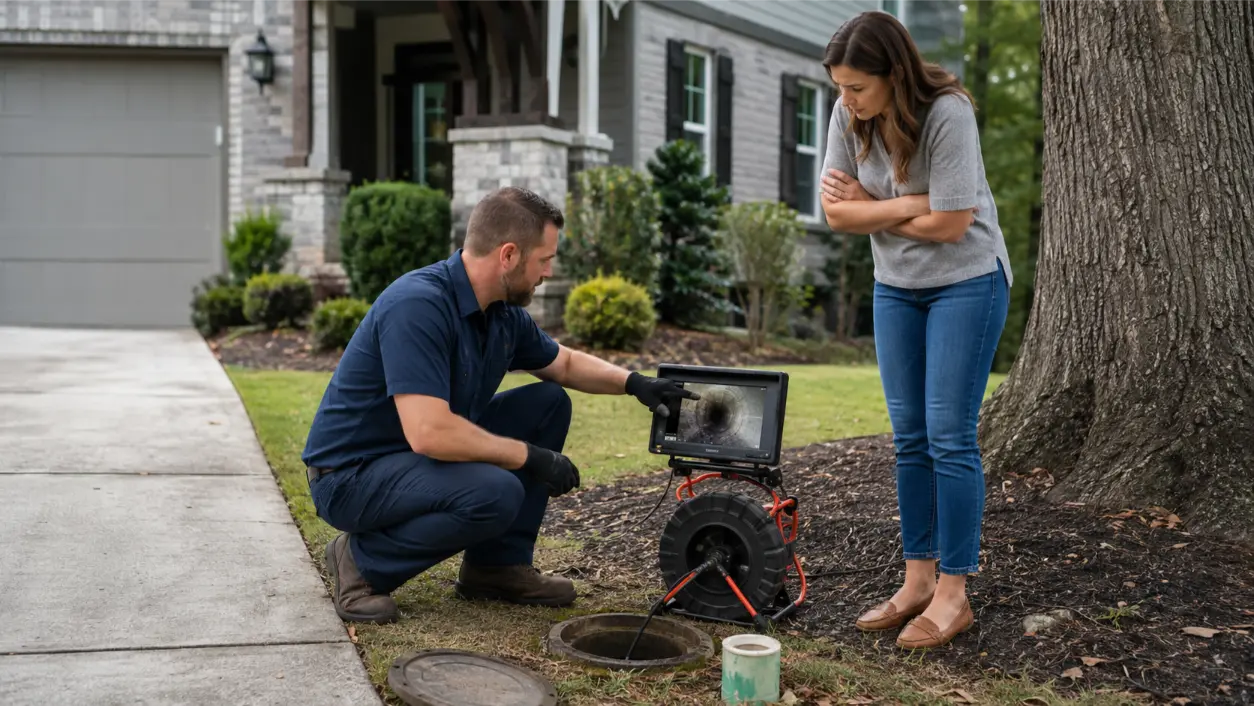
If your sewer line keeps backing up, especially after it has already been cleaned or snaked, there may be more going on than a simple clog.
A sewer backup is usually a symptom. The more important question is what keeps causing wastewater to stop flowing properly in the first place.
Sometimes the answer is relatively straightforward, such as grease, wipes, or another obstruction. In other cases, recurring sewer backups can point to tree root intrusion, aging cast iron pipes, cracks, deteriorated joints, poor pipe alignment, or more serious structural damage.
That distinction matters because clearing a blockage and repairing the cause of a blockage are not always the same thing.
For homeowners in Atlanta, Marietta, Acworth, and surrounding Metro Atlanta communities, Daniel’s Plumbing can inspect the sewer line, identify what is actually causing the recurring problem, and determine whether the right next step is cleaning, repair, trenchless pipe rehabilitation, or another solution.
CTA: Sewer Keeps Backing Up? Schedule a Camera Inspection
A Sewer Backup Is Usually a Symptom, Not the Root Problem
An occasional clogged drain does not automatically mean something is wrong with your main sewer line.
A bathroom sink can clog from hair. A kitchen drain can slow because of grease and food buildup. A toilet may become blocked by excessive paper or another object.
Those are individual drainage problems.
A recurring sewer backup is different.
If multiple fixtures are affected, wastewater repeatedly comes back through lower drains, or the same sewer line needs to be cleared again and again, it is worth investigating what is happening farther inside the plumbing system.
Many homeowners get caught in the same cycle:
Sewer backs up → line gets cleaned → drainage improves → sewer backs up again.
Cleaning may have successfully removed the immediate obstruction. But if something inside the pipe continues to catch debris, restrict flow, or allow roots to enter, another blockage can eventually develop.
If the same sewer line requires frequent cleaning, the important question becomes:
Why does material keep collecting there in the first place?
Here are seven of the most common possibilities.
1. Tree Roots Are Growing Into the Sewer Line
Tree roots can be a serious problem for underground sewer piping.
Roots naturally seek moisture. If an older sewer line develops a crack, deteriorated joint, or other opening, small roots may find their way into the pipe.
Once inside, they can continue growing.
The roots themselves restrict the pipe, but they can also create a net-like obstruction that catches:
- Toilet paper
- Waste
- Grease
- Wipes
- Debris
- Other material moving through the sewer line
Eventually, enough material accumulates to create a blockage.
A plumber may be able to remove or cut the roots and restore flow. However, that does not necessarily repair the defect that allowed the roots into the sewer pipe.
Why Do Tree Roots Keep Coming Back?
If roots are removed but the crack, joint, or opening remains, the underlying entry point may still exist.
That can lead to another cycle of root growth and sewer backups.
If your sewer line has been cleared of roots more than once, a camera inspection can help determine where the roots are entering and what condition the pipe is in around that area.
When the host pipe is still suitable for rehabilitation, trenchless methods such as CIPP may sometimes provide an option for addressing the damaged section rather than repeatedly treating the root intrusion.
2. Your Sewer Pipe Is Cracked or Damaged
A sewer line does not have to be completely collapsed to create recurring problems.
Cracks, fractures, deteriorated joints, and damaged sections can all interfere with reliable drainage.
A defect inside the pipe can create an uneven area where waste and debris begin to catch. Soil or roots may also enter through openings in the sewer line.
Over time, the restriction becomes large enough to cause another blockage.
Cleaning the pipe can restore flow, but it does not necessarily repair the damaged pipe wall.
That is why a sewer may seem completely normal after it has been snaked or cleaned, only to back up again weeks or months later.
Signs the Problem May Be Structural
You may want to investigate the sewer line itself if:
- The same line repeatedly backs up
- Cleaning only provides temporary relief
- Tree roots have been found more than once
- Multiple drains are affected at the same time
- A previous camera inspection showed cracks or damaged joints
- The sewer pipe is older and showing visible deterioration
The goal is to determine whether the blockage is the problem—or whether pipe damage is causing the blockage.
3. Aging Cast Iron Pipes Are Deteriorating
Older cast iron drain and sewer piping can develop significant interior deterioration as it ages.
A newer pipe typically has a relatively smooth interior that allows wastewater and solids to travel through the system.
A deteriorating cast iron pipe can be very different.
Over time, the interior may develop:
- Corrosion
- Rust and scaling
- Rough surfaces
- Deposits and buildup
- Reduced internal diameter
- Cracks
- Deteriorated pipe walls
Those rough surfaces can make it easier for paper, waste, grease, and other material to catch inside the pipe.
The result may be a sewer line that seems to keep clogging even after it has been professionally cleaned.
When Drain Cleaning Stops Being the Complete Solution
Drain cleaning serves an important purpose. If there is material blocking the pipe, removing that material can restore drainage.
But cleaning cannot automatically correct:
- Corroded pipe walls
- Structural cracks
- Deteriorating cast iron
- Damaged joints
- Other physical defects in the pipe
If deterioration of the pipe itself is contributing to recurring backups, the conversation may eventually need to shift from:
“How do we clear this clog?”
to:
“How do we repair or rehabilitate the pipe causing these clogs?”
Depending on the condition of the existing cast iron line, trenchless CIPP pipe lining may be one rehabilitation option worth evaluating.
4. Grease, Waste, Wipes, or Debris Keep Building Up
Not every recurring sewer backup is caused by structural pipe damage.
Sometimes the problem really is repeated accumulation inside the line.
Common causes include:
- Cooking grease
- Food waste
- Excessive toilet paper
- “Flushable” wipes
- Hygiene products
- Foreign objects
- Other materials that should not enter the sewer system
Grease can be especially troublesome because it may cool and stick to the interior of a drain line. Other debris then adheres to that buildup, gradually restricting the pipe.
If the sewer line is otherwise in good condition, proper cleaning and better plumbing habits may be all that is needed.
However, repeated buildup can sometimes be worsened by other conditions.
For example, a badly corroded cast iron pipe provides a rougher surface for material to collect on than a smooth pipe. A damaged joint or improperly flowing section can also create a place where solids repeatedly accumulate.
That is another reason why frequent sewer cleaning should eventually raise the question of why the blockage keeps forming in the same area.
5. The Sewer Line Has a Belly or Improper Slope
Sewer lines rely on gravity to move wastewater toward the appropriate downstream connection.
The pipe must maintain proper slope so water and solids continue moving through the system.
If a section of pipe settles and creates a low point, sometimes called a sewer-line belly, wastewater may collect there instead of draining completely.
Solids can then settle in the low area and gradually create a blockage.
Possible symptoms may include:
- Frequent sewer clogs
- Slow drainage
- Standing water visible during a camera inspection
- Repeated blockages in the same section of pipe
This is also an important example of why the correct diagnosis matters before choosing a repair method.
CIPP pipe lining follows the existing path and geometry of the host pipe. It does not automatically lift a severely sagging sewer line or correct a major slope problem.
If improper alignment is the underlying cause, another repair method may be necessary.
6. The Sewer Line Is Partially Collapsed or Severely Deteriorated
More serious structural deterioration can also cause a sewer line to keep backing up.
A pipe may become deformed, partially collapse, separate, or deteriorate to the point where wastewater can no longer flow reliably through the line.
Depending on the severity of the problem, signs may include:
- Backups returning quickly after cleaning
- Significant restriction visible on camera
- Heavy soil or root intrusion
- A camera unable to pass through the damaged area
- Visible deformation or missing sections of pipe
- Persistent drainage problems despite repeated service
A severely damaged sewer line may require more than cleaning.
And importantly, not every collapsed pipe is a candidate for CIPP.
Trenchless pipe lining generally requires a host pipe that remains suitable for rehabilitation. If the original line has lost too much of its shape or structural continuity, conventional repair, replacement, or another trenchless technique may make more sense.
This is why Daniel’s Plumbing focuses on diagnosing the pipe before recommending the repair.
7. The Problem May Be Farther Downstream
Sometimes the backup is not being caused by the section of sewer line you initially suspect.
The obstruction may be farther downstream in private piping, shared plumbing, or another part of the drainage system.
Multi-family and commercial properties can become even more complicated because several fixtures, units, floors, or plumbing branches may ultimately connect into larger drain lines.
Depending on the situation, wastewater backing up at one location may be the result of a restriction somewhere else in the system.
That is why locating the actual obstruction is so important.
A sewer backup does not automatically mean an entire sewer line needs replacement.
Before making a major repair decision, the plumbing system should be evaluated to identify:
- Where the restriction is located
- What is causing it
- Whether the pipe itself is damaged
- How extensive the affected area is
Why Does My Sewer Back Up Again After It Was Cleaned?
This is one of the most important questions homeowners ask.
The answer is often the difference between clearing an obstruction and fixing what caused the obstruction.
Imagine tree roots have grown through a deteriorated sewer joint.
A plumber removes the roots.
Water begins flowing again.
The cleaning worked.
But the opening where the roots entered is still there.
Over time, roots may enter again and another blockage develops.
The same concept can apply to deteriorating cast iron pipe.
A professional cleaning may remove heavy buildup and improve drainage dramatically. But if the interior pipe walls remain badly corroded and rough, material may begin accumulating there again.
That does not mean drain cleaning was performed incorrectly.
It means the cleaning addressed the immediate obstruction while another condition continues to contribute to the recurring problem.
If your sewer backs up after cleaning or repeatedly needs to be snaked, a sewer camera inspection can help determine whether there is an underlying pipe defect that needs attention.
What Should You Do If Your Sewer Line Keeps Backing Up?
If your sewer line keeps backing up, especially after repeated cleaning, the next step should usually be to determine what is happening inside the pipe.
A professional sewer camera inspection can reveal conditions that cannot be diagnosed from the surface alone.
Depending on the system, the camera may identify:
- Tree roots
- Cracks and fractures
- Corrosion
- Cast iron deterioration
- Damaged joints
- Heavy buildup
- Standing water
- Deformation
- Partial collapse
- Other obstructions
The key benefit is that the inspection helps separate a:
clog problem
from a:
pipe problem
That difference can completely change the repair recommendation.
If the pipe is structurally sound and simply needs cleaning, there may be no reason to consider rehabilitation.
If the inspection shows that structural deterioration is causing recurring problems, then repairing the pipe may provide a more meaningful long-term solution.
CTA: Find Out Why Your Sewer Keeps Backing Up
What If the Sewer Pipe Itself Is Causing the Backups?
If inspection shows that the sewer line is damaged but remains a good candidate for rehabilitation, CIPP trenchless pipe lining may be an option.
CIPP stands for Cured-In-Place Pipe.
Instead of excavating and removing the entire existing line, a resin-saturated liner is installed inside the damaged host pipe and cured in place.
The result is essentially a new pipe inside the old pipe.
Depending on the condition of the existing sewer or drain line, CIPP may be considered for problems such as:
- Cracked pipes
- Deteriorating cast iron
- Damaged joints
- Root-affected sections after proper cleaning and preparation
- Corroded sewer and drain lines
- Pipes located underneath difficult-to-access areas
For qualifying pipes, CIPP can also significantly reduce the excavation associated with conventional replacement.
That can be especially valuable when the sewer line runs underneath:
- Landscaping
- Driveways
- Concrete
- Patios
- Floors
- Other finished areas
Instead of repeatedly treating the backup, rehabilitating the damaged pipe may address the condition that is helping the backups return.
Does a Recurring Sewer Backup Mean I Need a New Sewer Line?
No. Not automatically.
Repeated backups tell you there is a recurring problem. They do not tell you what the correct repair is.
Depending on what an inspection reveals, the solution could involve:
- Professional sewer cleaning
- Root removal
- Localized pipe repair
- CIPP trenchless pipe lining
- Another trenchless repair method
- Conventional excavation and replacement
The most aggressive solution is not automatically the best solution.
The goal should be to choose the repair that addresses the actual condition of the sewer line.
That is why inspection and diagnosis are so important before committing to major plumbing work.
Recurring Sewer Backups in Atlanta-Area Homes
If you’re dealing with repeated sewer backups in Atlanta, Marietta, Acworth, Kennesaw, Woodstock, Cobb County, or surrounding Metro Atlanta communities, Daniel’s Plumbing can help determine why the problem keeps returning.
Whether the cause turns out to be tree roots, deteriorating cast iron, recurring buildup, damaged pipe, or another sewer-line condition, understanding the underlying problem is the first step toward selecting the right repair.
For qualifying damaged pipes, Daniel’s Plumbing also provides advanced CIPP trenchless pipe rehabilitation, which may allow sections of sewer and drain piping to be restored internally while minimizing the extensive excavation associated with traditional pipe replacement.
Frequently Asked Questions About Recurring Sewer Backups
Why does my sewer keep backing up?
Recurring sewer backups can be caused by repeated blockages, tree roots, cracked pipes, deteriorating cast iron, grease and debris buildup, poor pipe slope, partial collapse, or another downstream restriction.
A camera inspection can help identify which condition is affecting your sewer line.
Why does my sewer back up after being snaked?
Snaking can remove or break through an obstruction without correcting the condition that caused it.
If roots, corrosion, a damaged joint, or another defect remains, material may begin collecting again and another backup can eventually occur.
How many sewer backups are too many?
There is no universal number, but repeated backups from the same sewer line are a strong reason to investigate the underlying cause.
If you are repeatedly paying to clear the same line, a camera inspection may provide more useful information than simply assuming every backup is another unrelated clog.
Can tree roots cause repeated sewer backups?
Yes. Roots can enter sewer lines through cracks, deteriorated joints, and other openings.
They can restrict flow and catch waste and debris, creating recurring blockages.
Removing the roots may restore drainage, but the condition that allowed them into the pipe may still need to be addressed.
Can old cast iron pipes cause recurring clogs?
Yes. Aging cast iron piping can develop corrosion, scale, rough interior surfaces, and other deterioration that makes it easier for material to collect inside the line.
Repeated clogs in an older cast iron system may justify a camera inspection to evaluate the condition of the pipe itself.
Will CIPP stop my sewer from backing up?
CIPP may help when recurring backups are associated with qualifying structural defects in the existing pipe.
It is not a universal cure for every sewer backup. Problems such as major slope issues or severely collapsed pipe may require another repair approach.
The sewer line should be inspected before CIPP is recommended.
Do I need to replace my entire sewer line?
Not necessarily.
Depending on the cause and extent of the problem, the appropriate solution may range from cleaning or localized repair to trenchless pipe rehabilitation or conventional replacement.
Stop Clearing the Same Sewer Problem Over and Over
If your sewer line keeps backing up, another cleaning may restore drainage.
But if the same problem continues to return, it may be time to find out why.
Daniel’s Plumbing can inspect your sewer line, locate the underlying issue, and determine whether you’re dealing with a straightforward blockage, recurring root intrusion, deteriorating cast iron, structural pipe damage, or another problem.
And if the pipe itself is damaged but remains suitable for rehabilitation, CIPP trenchless pipe lining may provide a way to address the underlying condition while reducing the excavation and property disruption associated with traditional pipe replacement.
Instead of guessing at the next repair, start with a clear diagnosis.
Find Out Why My Sewer Keeps Backing Up. Schedule a Sewer Camera Inspection
Proudly serving homeowners and businesses throughout Atlanta, Marietta, Acworth, and surrounding Georgia areas.
RELATED LINK:
U.S. Environmental Protection Agency — Sanitary Sewer Overflow (SSO) Frequent Questions