
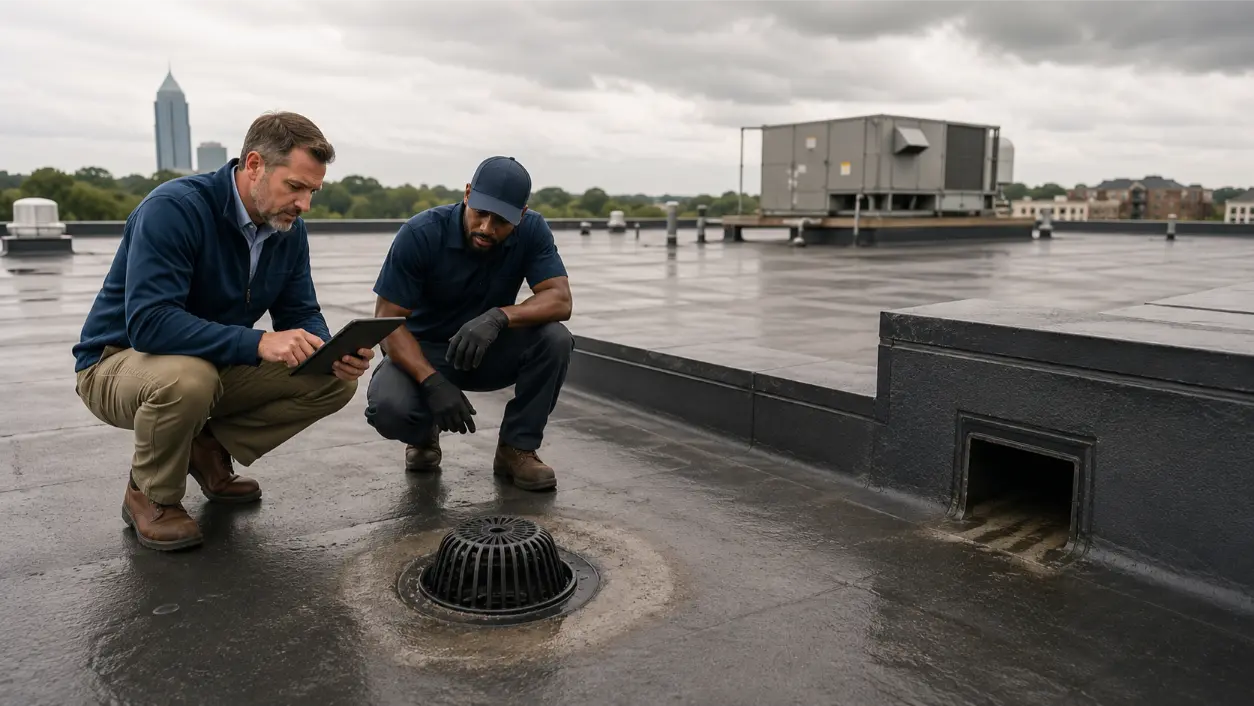
A roof drain backing up during heavy rain can look like an ordinary plumbing leak from inside a commercial building. Water may show up around a ceiling penetration, run down a column, drip near a wall, or appear above a restroom or mechanical room. The timing is the first clue: if the symptom appears only during rain and fades when the storm passes, the problem may involve the roof-drain or storm-drain system rather than a pressurized water line or fixture leak.
For a facility manager, the goal is not to diagnose the entire system from the floor below. It is to document the pattern, identify whether primary and overflow drainage paths are working, and bring the right trade to the problem with useful evidence. That can reduce repeat service calls and help separate a simple blockage from a damaged drain line, failed connection, roof condition, or broader stormwater issue.
Why a Roof-Drain Problem Can Look Like Interior Plumbing
Roof-drain piping often travels through the building before discharging to an approved stormwater location. When that piping is restricted, cracked, separated, corroded, or leaking at a fitting or drain connection, rainwater can appear inside occupied space even though no sink, toilet, or domestic water line has failed.
Water can travel along piping, framing, insulation, or structural members before it becomes visible, so a ceiling stain may not sit directly below the defect. Start with timing: a leak that closely tracks rainfall points the investigation toward roof membranes, drains, storm piping, scuppers, and related penetrations, while a dry-weather leak may point somewhere else.
Roof-Drain Basics: Primary and Secondary Drainage
Commercial low-slope roofs commonly use primary roof drains or gutters to move rainwater away from the roof. Where roof construction can trap water if the primary system does not keep up, current plumbing codes may require a separate secondary or emergency drainage path such as overflow drains or scuppers. In Georgia, the 2024 International Plumbing Code with Georgia amendments took effect January 1, 2026, and its storm-drainage chapter includes requirements for secondary emergency roof drainage in applicable conditions.
The primary system handles normal drainage; the secondary system provides another path when water accumulates because the primary path is blocked, overloaded, or otherwise not working as intended. An overflow discharging where maintenance staff can see it can be an important warning sign. Exact requirements depend on the building, roof geometry, jurisdiction, design, and applicable code edition.
Five Patterns That Help Narrow the Problem
1. The Leak Happens Only During Heavy Rain
This is the classic trigger. Light rain may produce no symptom, while a short intense storm creates dripping or ceiling staining. That pattern can indicate a restriction that only becomes apparent at higher flow, an overflow pathway that is not working as intended, a deteriorated storm line, or a roof-system issue that appears only when water depth increases.
Record whether the symptom begins immediately, after sustained rainfall, or only during the heaviest part of the event. That timeline can help distinguish surface water entry from drainage-system behavior.
2. Water Appears Near a Roof-Drain Leader or Vertical Stack
If drawings or prior repairs show a storm leader nearby, corrosion, failed joints, cracks, offsets, or previous modifications deserve attention. Before opening finished ceilings or walls, a camera inspection, accessible cleanout, drain test, or other diagnostic method may provide better evidence.
3. Water Ponds Around a Roof Drain
Standing water around a drain after nearby areas have cleared can indicate debris at the strainer, a restricted drain body or leader, insufficient slope, or another roof-design or maintenance issue. Leaves, roofing granules, trash, vegetation, and windblown debris can reduce inlet capacity surprisingly quickly.
If a secondary drain or scupper begins flowing, document it. That is evidence that the drainage system needs attention even if water has not entered occupied space.
4. A Roof Drain Smells Like Sewer
A sewer-like odor near a roof drain does not automatically mean sewage is backing up through the roof system. Odor can come from organic debris, stagnant water, nearby sanitary venting, or an improper connection that requires investigation. Storm drainage and sanitary drainage have different functions, and unexpected odor is a reason to inspect rather than assume.
For facility staff, the useful step is to record where and when the odor occurs and whether it changes with rainfall, HVAC operation, or drain use elsewhere in the building. That information can help narrow the source.
5. The Same Area Has Been Patched More Than Once
Repeated ceiling repairs or roof patches in the same zone can mean the symptom is being treated without resolving the cause. Review work orders, leak maps, photos, and prior repairs for a recurring storm-drain pattern.
What to Check Before the Next Storm
A preventive inspection is most useful before forecasted heavy rain, not while staff are trying to contain an active leak. Roof access should be limited to authorized personnel following the building’s fall-protection and site-safety procedures.
- Primary drain inlets: Confirm strainers, domes, and nearby roof surfaces are clear of leaves, trash, roofing debris, and vegetation.
- Overflow drains and scuppers: Verify that visible openings are not blocked, covered, sealed, or obstructed by stored materials or later construction.
- Evidence of ponding: Look for water marks, sediment rings, staining, or vegetation that suggests water routinely remains around a drain.
- Interior storm piping: Check accessible vertical leaders, horizontal runs, hangers, joints, and cleanouts for corrosion, staining, or prior patching.
- Ceiling history: Mark prior leak locations on a floor plan so the pattern can be compared with roof-drain and storm-pipe routes.
- Discharge points: Make sure accessible outlets are not buried, blocked, damaged, or discharging where water immediately returns toward the building.
- Recent roof work: Note coatings, reroofing, equipment installation, or penetrations that may have changed drainage paths or covered a drain component.
Daniel’s Plumbing Services lists commercial plumbing, drain cleaning, sewer cleaning and repair, CIPP, and pipe rehabilitation among its commercial and drainage services. That makes it useful to bring documented storm-only patterns to the service call rather than simply reporting “a ceiling leak.”
A Roof Drain Maintenance Checklist for Facility Teams
- Keep a roof and drain map showing primary drains, overflow drains, scuppers, leaders, cleanouts, and known discharge points.
- Inspect accessible drain inlets on a recurring schedule and after major wind or storm events.
- Photograph each drain area from the same angle so changes in debris, ponding, or roof condition are easier to compare.
- Log every interior leak by date, time, rainfall condition, floor, room, and approximate duration.
- Note whether an overflow drain or scupper was active during the event.
- Track recurring odor, gurgling, slow drainage, or water noise in storm leaders.
- Preserve camera-inspection videos and repair records with the building’s plumbing documents.
- Coordinate roof and plumbing contractors when the symptom could involve both the roof surface and internal storm piping.
The strongest maintenance record connects roof conditions to what happened inside: storm time, drain location, overflow behavior, photos, and prior history.
When a Plumber May Recommend Camera Inspection or Cleaning
If a roof drain repeatedly slows, overflows, or leaks inside the building, a plumber may need to evaluate the line rather than only the drain opening. Depending on access and pipe configuration, that can include cleaning, flow testing, or CCTV camera inspection.
A camera can help identify corrosion, scale, offsets, cracks, separations, or obstructions that are not visible from the roof. Cleaning may fit a sound but restricted pipe; structural deterioration may require repair. A blocked drain basket, damaged drain body, failed roof detail, and cracked vertical storm leader can create different symptoms and need different solutions.
![# 4 Step Article Project Instructions Use the `article-4-step` Skill for every article workflow. ## Workflow Always complete all five stages in order: 1. Article Brief 2. Full Article 3. Rank Math SEO 4. Official External Links 5. Image Prompts Do not stop for approval between stages when all required inputs are available. ## Input Rules ### Company Profile The current Company Profile remains active across article runs until the user explicitly says **“new company.”** If the user says **“new company”**: * Do not reuse the previous Company Profile. * Require a new Company Profile. * Require a fresh Topic Row. ### Topic Row **Never reuse a Topic Row.** Every article run requires a fresh Topic Row, even when the company stays the same. If the active Company Profile exists but no fresh Topic Row is provided, ask only for the new Topic Row. Never infer, recycle, or carry forward a Topic Row. ## Source of Truth Use the active Company Profile for: * Company positioning * Services/offers * Audience * Brand voice * Geographic market * CTAs * Compliance boundaries * Internal links * Claims requiring qualification Do not invent company facts, services, guarantees, certifications, proof, locations, or offers. Use the fresh Topic Row for: * Topic * Audience * Search intent * Primary keyword * Secondary keywords * Trigger/problem * Article angle ## Article Requirements Create a complete SEO-focused informational article, about 1,500–2,000 words when appropriate. Requirements: * Exact primary keyword naturally in the first paragraph. * One H1 only. * Use H2/H3 as needed. * No H5. * Practical, specific, useful, non-repetitive. * Match brand voice. * Include checklist/steps when relevant. * Include FAQ. * Include a soft company CTA near the end. * Qualify conditional claims. * Avoid unsupported guarantees, statistics, legal, financial, safety, performance, or superlative claims. * Add a disclaimer for regulated, technical, safety, medical, financial, legal, construction, insurance, immigration, credit, or similar high-risk topics. ## Research Verify current/changing facts with web research. For legal, government, regulatory, technical, safety, or similar claims, prefer: * Government agencies * Standards bodies * Universities * Official manufacturers Do not use direct competitors as external supporting sources. Do not invent unsupported facts. ## Internal Links Add useful contextual internal links naturally inside the article. Use only URLs from: * The active Company Profile, or * The verified current company website. Embed internal links directly in the clean HTML. Internal links open in the same tab. Do not use `target="_blank"` for internal links. Do not force irrelevant links. ## External Links Use official, authoritative, noncompetitive sources. External links must use: `target="_blank" rel="noopener noreferrer"` Include the main recommended external resource at the bottom of the HTML exactly as: `<br>` `<p><strong>RELATED LINK:</strong> <a href="OFFICIAL-URL" target="_blank" rel="noopener noreferrer">Source Name — Resource Title</a></p>` ## Rank Math SEO Generate: * SEO Title * URL Slug * Meta Description * Primary Focus Keyword * At least 15 Secondary Keywords Rules: * Exact primary keyword verbatim in SEO Title. * Exact primary keyword verbatim in URL slug where technically practical. * Exact primary keyword verbatim in Meta Description. * Avoid keyword stuffing. ### Copy-Ready SEO Keep the SEO fields in this order: 1. SEO Title 2. URL Slug 3. Meta Description 4. Keywords #### SEO Title Return only the finished SEO title value. #### URL Slug Return only the slug. Do not include: * `URL` * `Slug` * `URL Slug` * Domain * Explanation #### Meta Description Return only the finished meta description. Do not include: * `Meta Description` * `Description` * Character count * Commentary #### Keywords Combine the Primary Focus Keyword + all Secondary Keywords into one comma-separated line. Primary keyword must be first. Return only the comma-separated keyword line. Do not include: * `Primary Keyword` * `Secondary Keywords` * `Keywords` * Any explanatory label ## DOCX Rank Math Formatting The DOCX Rank Math section must also be copy-ready and use this order: 1. SEO Title 2. URL Slug 3. Meta Description 4. Keywords For **URL Slug and Meta Description**, show only the raw values. Do not place descriptive labels or titles immediately above, beside, or inside those values. Correct: `roof-drain-backing-up` `A roof drain backing up during heavy rain can signal blockage or pipe damage...` Incorrect: `URL Slug: roof-drain-backing-up` `Meta Description: A roof drain backing up...` Keep the SEO Title and combined keyword line clean and easy to copy as well. ## Clean HTML Return the complete article as clean copy-ready HTML using: * `<h1>`, `<h2>`, `<h3>` * `<p>` * `<ul>`, `<ol>`, `<li>` * `<strong>`, `<em>` * `<a>` Do not include CSS, scripts, schema, page-builder code, or Markdown inside the HTML. Embed contextual internal links directly in the HTML and include the RELATED LINK at the end. ## DOCX Deliverable Create one professional DOCX containing: * Full article * Rank Math SEO * Official External Links * Internal Links Used * Featured Image Prompt * Supporting Image Prompt 1 * Supporting Image Prompt 2 Requirements: * Letter size * Portrait * Professional typography * Clear heading hierarchy * Readable spacing/margins * Working hyperlinks * Copy-ready Rank Math values Render the DOCX to page images and visually inspect every page. Fix clipping, bad page breaks, orphan headings, crowded text, broken links, overflow, and inconsistent spacing. Deliver only the final DOCX unless QA files are requested. ## Image Prompts Create exactly three: 1. Featured Image 2. Supporting Image 1 3. Supporting Image 2 Each must be: * Realistic * Premium editorial photography * Horizontal 16:9 * Directly relevant * A different scene * Naturally lit * Suitable for blog cropping with negative space Avoid readable text, logos, watermarks, split screens, floating UI, exaggerated arrows, fake statistics, guaranteed-result imagery, cartoons unless requested, and obvious AI artifacts. ## Run Isolation Do not carry article-specific material from one article to another, including: * Topic Rows * Keywords * Article angles * Search intent * Titles * FAQs * External links * Image concepts **Company Profile persists until “new company.”** **Topic Row never persists. Every article requires a fresh Topic Row.** ## Final Response Use this structure: Completed using the Company Profile and Topic Row. ### 1. Article + SEO + External/Internal Links + Image Prompts [Download the DOCX] ### 2. Clean HTML — Copy Ready ```html [COMPLETE HTML] ``` ### 3. SEO Title — Copy Ready ```text [SEO TITLE ONLY] ``` ### 4. URL Slug — Copy Ready ```text [URL SLUG ONLY] ``` ### 5. Meta Description — Copy Ready ```text [META DESCRIPTION ONLY] ``` ### 6. Featured Image Prompt — Copy Ready ```text [PROMPT] ``` ### 7. Supporting Image Prompt 1 — Copy Ready ```text [PROMPT] ``` ### 8. Supporting Image Prompt 2 — Copy Ready ```text [PROMPT] ``` ### 9. Keywords — Copy Ready ```text [PRIMARY KEYWORD], [SECONDARY KEYWORD 1], [SECONDARY KEYWORD 2], [...] ``` Drain Pipe | daniels Plumbing](https://danielsplumbingservices.com/wp-content/uploads/ChatGPT-Image-Aug-7-2026-05_32_18-PM.webp "Roof Drain Problems That Look Like Plumbing: What Facility Managers Should Check")
When Roof-Drain Pipe Lining May Be an Option
For some non-pressurized roof-drain and storm-drain piping, cured-in-place pipe lining can be a rehabilitation option after inspection confirms that the host pipe and project conditions are suitable. Daniel’s Plumbing Services is a NuFlow certified partner and describes NuDrain CIPP as a way to rehabilitate drain, sewer, storm-water, and roof-drain piping from inside the existing line.
NuFlow’s own technical information lists roof-drain systems among the applications for NuDrain and describes a process that begins with camera inspection and cleaning before a resin-saturated liner is installed and cured inside the host pipe. Because the existing pipe remains in place, lining may reduce the need to open finished ceilings, walls, slabs, or other building areas in some projects.
Lining is not automatic. Access, diameter, material, geometry, branch connections, pipe condition, code requirements, and the exact defect affect whether CIPP is appropriate; some conditions still require conventional repair or replacement. If lining appears relevant, review Daniel’s Plumbing Services’ pipe repair and NuDrain information and ask for a project-specific assessment.
When to Escalate the Problem Immediately
Escalate promptly when water is accumulating on the roof, secondary drainage is flowing unexpectedly, ceiling materials are saturated or sagging, water is near electrical equipment, or a recurring leak is expanding. Facility personnel should restrict access to affected areas when falling materials, electrical hazards, or slip hazards are possible.
A roof carrying significant standing water can involve structural concerns outside the scope of a plumbing article. Do not send unqualified staff onto a wet roof to clear a drain during a storm. Use the building’s emergency procedures and appropriate roofing, plumbing, electrical, or structural professionals as the situation requires.
How Daniel’s Plumbing Services Can Help
Daniel’s Plumbing Services provides residential and commercial plumbing support across Atlanta, Marietta, Acworth, and surrounding Georgia communities, including drain cleaning, sewer cleaning and repair, CIPP, pipe rehabilitation, and other service work. For a facility manager dealing with a recurring roof-drain leak or backup, the useful starting point is a clear symptom history and access to any available plumbing drawings or prior inspection records.
If your building develops leaks only during heavy rain, water backs up around roof drains, or an internal storm line may be deteriorating, contact Daniel’s Plumbing Services to discuss an inspection and the appropriate next step. The final repair path depends on the actual cause, pipe condition, roof system, access, and applicable local requirements.
Frequently Asked Questions
Why is my roof drain backing up during rain?
Possible causes include debris at the inlet, a restriction farther down the storm line, damaged or deteriorated piping, or a drainage system that is not moving water as expected during higher rainfall. The cause should be verified before deciding on cleaning or repair.
Can a roof drain leak inside a commercial building?
Yes. Roof-drain bodies, connections, and internal storm-drain piping can develop leaks or defects that allow rainwater to appear inside the building. Because water can travel along building materials, the visible stain may not be directly below the defect.
Why would a roof drain smell like sewer?
A sewer-like odor can have several causes, including debris, stagnant water, nearby sanitary venting, or an improper connection. Odor alone does not identify the source, so the location, timing, and drainage layout should be inspected.
What is the purpose of an overflow roof drain or scupper?
Secondary emergency drainage provides another path for rainwater when the primary drainage system cannot remove water as intended. Requirements vary by roof configuration and code, so the building’s design documents and applicable local code should control.
Can a backed-up roof drain be lined instead of replaced?
Sometimes. CIPP lining can be used in certain roof-drain and storm-drain systems, but only after inspection confirms that the pipe, access, geometry, and defect are suitable for the method. Other situations may require cleaning, localized repair, drain-body work, or conventional replacement.
How often should commercial roof drains be inspected?
There is no single interval that fits every building. Inspection frequency should reflect roof type, tree coverage, debris exposure, storm history, manufacturer or roof-consultant guidance, and the facility’s maintenance plan. Drains should also be checked after significant storms or work that may introduce debris.
This article provides general facility-maintenance and plumbing information. Roof drainage, structural loading, fall protection, electrical hazards, code compliance, and repair design are site-specific. Use qualified professionals and the applicable Georgia/local codes, building documents, manufacturer requirements, and safety procedures for inspection and repair decisions.
RELATED LINK: International Code Council — 2024 International Plumbing Code with Georgia Amendments, Chapter 11 Storm Drainage