
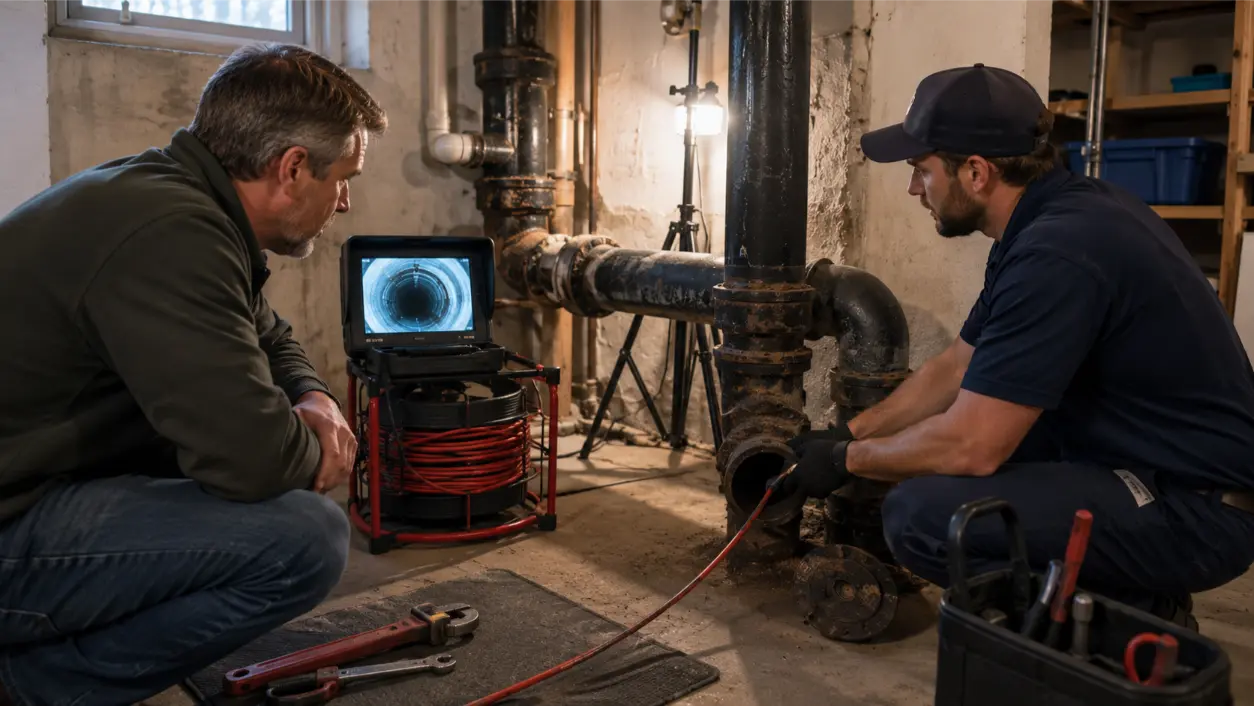
Cast iron sewer pipe problems can be confusing because the first symptom often looks like an ordinary clog. A drain slows down, the line is cleaned, and everything seems normal again—until the same bathroom, branch line, or main drain starts backing up a few weeks or months later. At that point, the question changes from “What is blocking the pipe?” to “Why does this section keep becoming a problem?”
Older cast iron drain and sewer piping does not automatically need replacement simply because of its age. Cast iron remains a recognized drain, waste, and vent material. But an older line can develop internal deposits, corrosion, rough surfaces, cracks, joint problems, deformation, or other defects that make repeated clogging more likely. Drain cleaning may restore flow, but it cannot rebuild missing pipe wall, correct a sagged line, or permanently repair structural damage.
Why Cast Iron Drains Can Keep Clogging After Cleaning
A new, smooth drain gives waste and water a relatively clear path. An aging cast iron line may look very different inside. Corrosion products and mineral deposits can create a rough, irregular interior. Debris that might have moved through a smoother pipe can catch on those surfaces. Grease, paper, hair, sediment, and other material can then collect around the restriction.
A cleaning can produce a real improvement without solving the underlying condition. Flow may return, but rough pipe walls, damaged joints, offsets, root-entry points, or other defects can remain and create places for new material to collect.
Daniel’s Plumbing Services discusses this symptom pattern in its guide to multiple slow drains and possible main-line problems: clearing a blockage is sometimes only the first step, especially when the problem returns.
What Drain Cleaning Can—and Cannot—Fix
Drain cleaning is an important plumbing service. When the problem is a removable obstruction, appropriate cleaning may be exactly what the line needs. It can clear grease, sludge, roots, scale, or accumulated debris depending on the pipe condition and the cleaning method selected by the plumber.
But cleaning and structural repair are different jobs.
- Cleaning can restore an open flow path. It may remove material that is narrowing or blocking the pipe.
- Cleaning does not replace missing pipe wall. If corrosion has created holes or severe wall loss, the pipe remains damaged after the blockage is gone.
- Cleaning does not close cracks or failed joints. Those defects may continue to admit roots, soil, or groundwater where site conditions allow.
- Cleaning does not correct a belly or bad grade. A low section that retains water remains low after the line is cleaned.
- Cleaning does not realign a displaced pipe. A significant offset or deformation may continue to catch solids.
This is why a homeowner who has paid for repeated cleanings should eventually ask for evidence about the pipe itself rather than assuming the next blockage is unrelated to the last one.
Warning Signs the Problem May Be More Than a Clog
The same line clogs again soon after service
One recurring clog does not prove structural failure. Usage, wipes, grease, foreign objects, or roots can all cause repeat problems. But when a specific line repeatedly slows after professional cleaning, record how long it stays clear and which fixtures are affected; that pattern is a reason to investigate the pipe itself.
A camera shows heavy scale or an extremely rough interior
Cast iron can develop internal buildup that reduces the effective opening and creates surfaces where debris catches. Cleaning may remove deposits, but the method should match the remaining pipe condition. A post-cleaning camera can show whether the line is reasonably open or still heavily deteriorated.
The pipe has cracks, holes, missing wall, or deteriorated joints
Once a camera identifies structural defects, the question becomes whether the defect can be rehabilitated, needs a targeted repair, or calls for replacement. Cured-in-place pipe lining is one trenchless method for qualifying gravity sewer pipes with defects such as cracks, leaks, and corrosion, but the host line must still be evaluated for suitability.
Roots or debris keep entering at the same location
Root cutting can restore flow, but if roots repeatedly enter through the same defective joint or opening, cutting the roots does not seal the entry point. The long-term repair should address the defect that allows the intrusion where practical.
Standing water remains in the pipe after cleaning
A small amount of water does not automatically indicate failure, but a persistent low section may point to grade or settlement. This matters because lining follows the existing route: it can rehabilitate pipe wall, but it does not lift a sagged section or create a new slope.
Why a Sewer Camera Inspection Changes the Decision
If a line is repeatedly cleaned without inspection, the homeowner may know blockages exist but not why they return. A sewer camera moves the discussion from symptoms to condition.
After the pipe has been cleaned enough for useful visibility, an inspection can help document:
- The location and length of heavily scaled or rough sections.
- Cracks, fractures, holes, missing wall, or corrosion.
- Joint offsets, separation, deformation, or collapse.
- Root-entry points and recurring debris locations.
- Standing water or suspected low areas.
- Changes in material, diameter, bends, and branch connections.
- Available access for a future repair or rehabilitation method.
The goal is not merely to find something wrong on camera. It is to match the defect to a repair method that actually addresses it.
Cleaning, Spot Repair, Lining, or Replacement?
Recurring cast iron problems do not all lead to the same solution. The inspection should determine the path.
Drain cleaning
Cleaning may remain appropriate when the pipe is structurally serviceable and the issue is primarily removable obstruction or buildup.
Targeted conventional repair
A localized excavation or floor opening can make sense when one short section is badly offset, collapsed, incorrectly graded, or otherwise unsuitable for lining. A targeted repair can also create better access for additional work.
CIPP pipe lining
NuDrain CIPP pipe lining creates a new pipe within a qualifying existing drain or sewer. Daniels Plumbing Services markets the system for non-pressurized applications such as sanitary drains, sewers, storm lines, and roof drains, with installation through available access points where the project allows.
CIPP is particularly useful when the host pipe has deterioration that can be rehabilitated internally and excavation would be disruptive. The pipe still needs appropriate cleaning, access, geometry, and remaining shape for the selected lining process.
Pipe replacement
Replacement may be the better path when a line is collapsed, severely deformed, poorly graded, inaccessible for the selected rehabilitation method, or being reconfigured for a larger plumbing project.
When Cast Iron Can Be a Good Candidate for CIPP
NASSCO identifies CIPP as a trenchless option for gravity sewer pipes affected by conditions including cracks, leaks, and corrosion. For a cast iron building drain or lateral, practical candidacy generally depends on whether the line can be inspected, cleaned, and prepared and whether the existing route can support the liner installation.
A plumber evaluating a cast iron line for lining should consider:
- How much of the original opening remains after cleaning.
- Whether the pipe is continuous enough for liner placement.
- Whether deformation or collapse blocks the path.
- The location of branches, fittings, and transitions.
- Whether standing water suggests a grade problem.
- The access points available inside or outside the building.
- The length and diameter of the proposed repair.
- Whether a localized conventional repair should be completed first.
This inspection-first approach is consistent with Daniel’s Plumbing Services’ broader drain cleaning, sewer repair, pipe lining, and CIPP service offering: first establish what the system needs, then choose the repair path.
When Lining May Not Solve the Real Problem
Pipe lining rehabilitates a suitable host pipe; it does not correct every defect. A proposal should be tied to clear camera findings.
Additional repair or replacement may be required when:
- The pipe is completely collapsed or obstructed so equipment cannot pass.
- A severe offset prevents proper preparation or liner installation.
- The line has a significant belly or inadequate slope.
- The layout itself needs to change.
- The pipe has a condition outside the selected lining system’s design limits.
- Connections or branch geometry require another repair approach.
Some properties need a hybrid plan: conventionally repair one failed section, then rehabilitate other qualifying sections with lining.
Questions to Ask Before Paying for Another Cleaning
- Why did this line clog again? Ask whether the plumber sees a recurring location or likely underlying cause.
- Has the line been camera-inspected after cleaning? Post-cleaning visibility is often more useful than trying to inspect through a heavy blockage.
- What does the pipe wall look like? Ask about scaling, corrosion, cracks, holes, joint condition, and deformation.
- Is there standing water or a suspected grade problem? This can change the repair options.
- Is the line a candidate for CIPP? Ask what specific conditions make it suitable or unsuitable.
- Would a localized repair solve the worst defect? One short failed section may not justify replacing the entire line.
- What will be verified after the repair? Camera documentation can help confirm the completed work.
- What does the quote include? Compare cleaning, access, lining, excavation, restoration, and any follow-up inspection.
How Daniel’s Plumbing Services Approaches Recurring Cast Iron Problems
Daniel’s Plumbing Services serves homeowners and businesses across Acworth, Marietta, Atlanta, and surrounding Georgia communities with drain cleaning, sewer cleaning and repair, service work, and specialty pipe lining.
For an older cast iron drain that keeps clogging, the next step is not automatically another cleaning or full replacement. Restore access as needed, inspect the line, identify the recurring defect, and compare repair paths based on actual condition.
Homeowners can make an appointment with Daniel’s Plumbing Services to discuss recurring backups, known cast iron deterioration, camera inspection, or whether a line may be suitable for trenchless rehabilitation.
Frequently Asked Questions
Does recurring clogging mean my cast iron sewer pipe has failed?
No. Repeated clogs can have several causes, including usage, roots, grease, scale, or structural defects. Recurrence is a reason to inspect the line, not proof that replacement is required.
Can drain cleaning remove cast iron scale?
Some cleaning methods can remove deposits and improve the internal opening, but the appropriate method depends on the pipe’s remaining condition. Cleaning does not restore pipe wall that has already been lost to corrosion.
What are common signs cast iron drain pipes are failing?
Possible warning signs include recurring backups, repeated clogs in the same section, heavy scale or corrosion visible on camera, cracks or holes, leaking joints, root entry, deformation, and sections that hold water because of settlement or grade issues. A camera inspection is needed to determine what those symptoms mean on a specific property.
Can a corroded cast iron sewer pipe be lined?
Often, qualifying cast iron gravity drains and sewers can be candidates for CIPP rehabilitation. The line must still be evaluated for access, cleaning, remaining shape, collapse, offsets, grade, diameter, and connection details.
Will CIPP fix a sagging cast iron drain?
No. A liner follows the existing path. If the pipe has settled and created a significant low spot, lining does not physically raise the pipe or create a new slope.
Should I replace all the cast iron plumbing in an older home?
Not based on age alone. The repair scope should be driven by condition, location, accessibility, performance, and the home’s broader renovation plans. Some lines may remain serviceable, some may be candidates for rehabilitation, and others may require targeted or full replacement.
This article provides general plumbing and construction information and is not a site-specific repair, engineering, code, or warranty recommendation. Pipe condition and repair suitability vary by property. Have recurring sewer or drain problems evaluated by qualified plumbing professionals, and obtain any permits or specialized review required for the project.
RELATED LINK: NASSCO — Pipe Rehabilitation and CIPP