
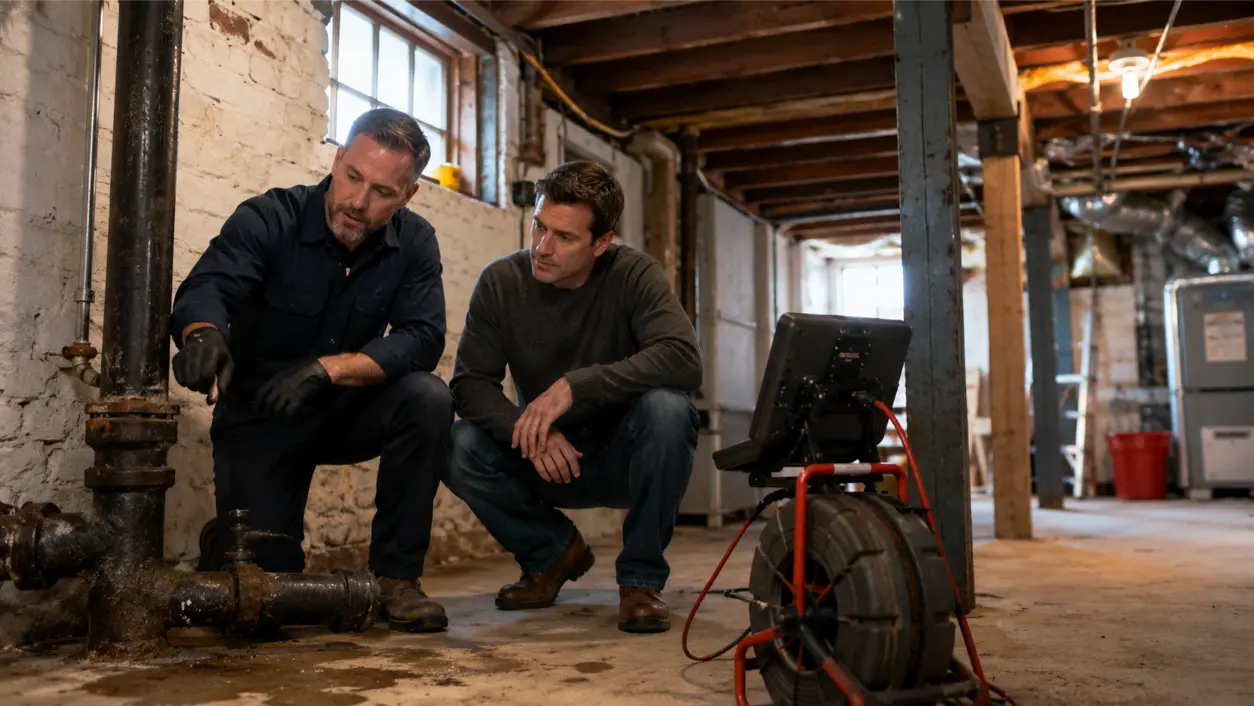
The most useful signs cast iron pipes are failing are not the age of the house alone. They are patterns: the same drain backing up repeatedly, sewer odors that return, rust or scale on exposed pipe, unexplained damp areas, slow drains throughout one part of the home, or camera footage showing corrosion, cracks, missing pipe wall, or damaged joints. Cast iron can remain serviceable for a long time, so an older system should not be condemned simply because it is old. But repeated symptoms deserve investigation before a small drainage problem becomes a larger repair.
Daniel’s Plumbing Services works on drain, sewer, and pipe-lining problems across Atlanta, Marietta, Acworth, and surrounding Georgia communities. As a certified NuFlow partner, the company also offers NuDrain CIPP rehabilitation for qualifying deteriorated drain and sewer piping. The key word is qualifying: inspection and cleaning should establish the pipe’s actual condition before anyone decides between maintenance, localized repair, lining, or replacement.
Why Cast Iron Drain Pipes Deteriorate
Cast iron is strong but not immune to deterioration. EPA condition-assessment guidance identifies internal and external corrosion as primary failure mechanisms for ferrous pipe, including cast iron. Over time, corrosion can produce pitting, metal loss, rough internal surfaces, holes, cracks, and breaks. Cast iron is also brittle, which can make cracking an important failure mode.
Drainage problems can also involve roots, deposits, grease, offset joints, pipe sags, and other defects. That is why homeowner symptoms do not always point to one cause. A backup may be caused by a removable obstruction, a damaged pipe, or both.
Sign 1: The Same Drain or Sewer Keeps Backing Up
One clog does not prove the pipe is failing. A repeated blockage in the same section is more significant, especially when the interval between cleanings becomes shorter.
Corroded cast iron can develop rough scale and pitting that catch paper, grease, hair, and solids. Roots can re-enter through cracks or joints after being cut. A sag can hold sediment. An offset joint can create a ledge where debris accumulates. EPA guidance identifies roots, sediment, grease, offset joints, and pipe sags as common flow restrictions in wastewater piping.
If a drain works immediately after cleaning but repeatedly returns to the same problem, ask whether the line was only reopened or whether its underlying condition was evaluated.
Sign 2: Several Fixtures Are Draining Slowly at the Same Time
A single slow sink may have a local fixture or branch-line problem. When several fixtures in the same part of the home slow down together, the restriction may be farther downstream.
Watch for combinations such as a toilet that bubbles when a nearby tub drains, a shower that slows while the washing machine discharges, or multiple lower-level fixtures that react together. These patterns can suggest a shared branch, building drain, or sewer restriction.
Slow drainage alone cannot distinguish between buildup and structural deterioration. But when the pattern is recurring in an older cast-iron system, it is reasonable to inspect the larger line instead of treating each fixture as an unrelated clog.
Sign 3: You Smell Sewer Odors That Keep Returning
Sewer odor can have simple causes, including a dry trap, loose fixture connection, or venting issue. It can also accompany drainage defects such as leaking joints, cracks, or deterioration in concealed piping.
Pay attention to odors that repeatedly appear in the same basement, crawlspace, wall area, mechanical room, or bathroom even after obvious fixture issues have been addressed. The location and timing can help a plumber narrow the investigation.
Do not use odor alone as proof of a broken cast-iron line. Sewer gases can come from multiple parts of the drainage and vent system. The value of the symptom is that it provides another reason to inspect when it appears alongside backups, visible corrosion, or moisture.
Sign 4: Exposed Cast Iron Shows Heavy Rust, Scale, Flaking, or Moisture
Exposed piping gives homeowners a rare opportunity to see part of the system directly. Surface rust does not automatically mean the pipe is structurally unsound, but heavy scaling, flaking, damp joints, active seepage, rust streaks, or obvious deterioration deserve professional attention.
External appearance also has limits. EPA materials discussing cast-iron corrosion note that deterioration can involve pitting and graphitization, meaning the visible surface may not always reveal the true remaining strength of the pipe. In drainage systems, internal deterioration may be more significant than what is visible from outside.
If an exposed section looks questionable, photograph it and note whether the area changes over time. A plumber can determine whether the problem is a joint, local section, condensation, external corrosion, or evidence of broader pipe deterioration.
Sign 5: Unexplained Damp Spots, Stains, or Water Damage Appear Near Drain Routes
A failing drain line does not always produce a dramatic leak. Small cracks, holes, or weakened joints can leak intermittently when fixtures discharge. In walls, ceilings, crawlspaces, or slab-adjacent areas, the first visible clue may be staining, dampness, odor, damaged finishes, or unexplained moisture.
These symptoms need prompt investigation because water damage can have causes beyond drain piping, including supply-line leaks, roof intrusion, condensate, groundwater, or waterproofing problems.
When the moisture appears near a known cast-iron stack, branch, or building drain and correlates with fixture use, the drainage system should be included in the diagnosis.
Sign 6: Camera Inspection Shows Corrosion, Cracks, Holes, or Damaged Joints
Some of the strongest signs of cast-iron failure are not visible to the homeowner at all. They appear during a sewer-camera inspection.
EPA condition-assessment guidance classifies defects such as cracks, fractures, broken pipe, holes, deformation, collapse, joint defects, and surface damage as structural concerns. For cast iron and other ferrous piping, corrosion is a major deterioration mechanism.
Camera footage may reveal:
- Heavy internal scale or tuberculation.
- Pitting and corrosion.
- Cracks or fractures.
- Holes or missing wall sections.
- Open, leaking, or offset joints.
- Root intrusion.
- Standing water associated with a sag or alignment issue.
- Deformation or partial collapse.
The camera should ideally be used after enough cleaning has occurred to expose the pipe surface. A pipe hidden behind grease, scale, or roots can be difficult to evaluate accurately.
Sign 7: Repairs Are Becoming More Frequent and Less Effective
Aging infrastructure often announces itself as a pattern rather than one catastrophic event. Maybe the kitchen branch was cleaned last year, the basement backed up six months later, roots were cut this spring, and now the same line is slow again.
The important question is whether each service call is fixing a new problem or repeatedly treating the same defect. If maintenance intervals keep shrinking, ask for the repair history to be viewed as one system-level problem.
NASSCO describes condition assessment as the first step in determining whether a compromised pipe should be maintained or rehabilitated. For homeowners, that means moving from symptom response to evidence: inspect the line, identify defects, and decide what level of intervention actually fits.
What a Camera Inspection Can Tell You
A sewer camera can help locate and document visible problems in accessible drainage piping. It can show where corrosion begins, where a joint is displaced, where roots are entering, whether water is standing in the line, and whether a cracked or deteriorated section appears localized or extensive.
It also has limitations. A camera does not directly measure every aspect of remaining wall thickness or structural strength, and heavy deposits can hide the pipe surface. Cleaning, access, pipe geometry, and the type of defect all affect what can be concluded.
For that reason, a good inspection is not simply a video. It should lead to a condition-based explanation of what the plumber sees and what repair paths remain reasonable.
Does Failing Cast Iron Always Need Full Replacement?
No. The appropriate repair depends on what failed and how severely.
- Maintenance: may be enough when the pipe is structurally serviceable and the problem is removable buildup.
- Localized repair: can address one damaged fitting, joint, or short section.
- CIPP rehabilitation: may be suitable for qualifying corroded, cracked, leaking, or deteriorated gravity piping that can be properly cleaned and prepared.
- Replacement: may be required when collapse, severe deformation, major offsets, inaccessible damage, slope problems, or other conditions cannot be corrected by lining.
NASSCO describes CIPP as a method that creates a seamless structural pipe inside a deteriorated host pipe and can address defects such as cracks, leaks, and corrosion. NuFlow’s NuDrain process likewise begins with CCTV inspection, measurement, and cleaning before a resin-saturated liner is installed. Those steps are important because not every old cast-iron line is an appropriate lining candidate.
When Should You Act Quickly?
Some cast-iron symptoms are suitable for a scheduled evaluation. Others deserve faster attention.
Contact a plumbing professional promptly when you have an active sewage backup, visible leaking from a drain or stack, rapidly spreading water damage, a collapsed or unusable sewer line, or repeated backups affecting multiple fixtures. Avoid using fixtures that worsen an active backup until the source has been evaluated.
Cast Iron Drain Pipe Warning-Sign Checklist
- Track how often the same drain or sewer backs up.
- Note whether multiple fixtures slow or react together.
- Record recurring sewer odors and where they occur.
- Inspect visible cast iron for heavy rust, flaking, moisture, or leaking joints.
- Investigate unexplained stains or damp areas near known drain routes.
- Review any prior camera footage for corrosion, cracks, holes, roots, or joint defects.
- Compare the dates and results of past drain-cleaning or repair calls.
- Request inspection when service intervals keep getting shorter.
- Have the line cleaned appropriately when deposits prevent a useful inspection.
- Compare maintenance, localized repair, CIPP, and replacement based on documented condition.
Frequently Asked Questions
What Are the Most Common Symptoms of Bad Cast Iron Pipes?
Recurring backups, slow drainage across multiple fixtures, sewer odors, visible corrosion or seepage, unexplained moisture, and camera evidence of corrosion, cracks, holes, roots, or damaged joints are all reasons to investigate. None of these symptoms alone proves that the entire system needs replacement.
Does Rust on Cast Iron Mean It Has to Be Replaced?
No. Light surface rust and severe structural corrosion are not the same condition. The significance depends on location, extent, leakage, internal condition, and remaining pipe integrity. Inspection is more useful than judging the entire system from one visible rust spot.
Can Corroded Cast Iron Be Lined Instead of Replaced?
Some deteriorated cast-iron drain and sewer lines can be rehabilitated with CIPP when the pipe can be properly inspected, cleaned, accessed, and prepared and its geometry falls within the lining system’s requirements. Severe collapse, deformation, offsets, or other defects may require replacement or localized excavation.
How Do I Know Whether My Cast Iron Is Failing or Just Clogged?
A one-time clog can occur in otherwise serviceable piping. Recurring blockages, shortening maintenance intervals, visible deterioration, leakage, or camera-documented defects make pipe condition more suspect. Cleaning followed by camera inspection can help separate removable buildup from structural deterioration.
Should I Replace All the Cast Iron in an Older House?
Not solely because of age. One part of a system may be serviceable, another may need cleaning or localized repair, and another may qualify for lining or replacement. A condition-based plan can prioritize the sections that actually show deterioration.
Do Not Wait for a Complete Failure to Learn What Is Happening
The best time to evaluate older cast-iron drains is often when warning signs are repetitive but the system is still accessible and functioning. Recurring backups, odors, visible corrosion, moisture, and increasingly frequent service calls can justify a closer look before the problem becomes an emergency.
Daniel’s Plumbing Services provides drain cleaning, sewer repair, pipe lining, and related plumbing services throughout Atlanta, Marietta, Acworth, and surrounding Georgia communities. As a certified NuFlow partner, the company can also evaluate whether NuDrain trenchless pipe rehabilitation may be appropriate for qualifying deteriorated cast-iron piping. Homeowners can contact Daniel’s Plumbing Services to schedule an inspection and discuss the condition of an older drain or sewer system.
Plumbing, construction, and technical disclaimer: This article provides general educational information and is not a site-specific plumbing, structural, engineering, code, or repair recommendation. Similar symptoms can have different causes, and cast-iron condition varies by pipe, environment, installation, access, and service history. A qualified plumbing or trenchless-rehabilitation professional should inspect the actual system before recommending cleaning, CIPP lining, excavation, replacement, or another repair method.
RELATED LINK: NASSCO — Assessment