
When tenants complain about repeated backups, property managers and facility managers need more than another temporary drain cleaning. They need to understand why the problem keeps returning, how much disruption a repair may create, and whether the building can avoid demolition-heavy pipe replacement.
That is where commercial pipe lining becomes worth evaluating. Cured-in-place pipe lining, often called CIPP, can rehabilitate certain existing drain, sewer, storm, and roof drain lines from inside the pipe. Instead of opening floors, walls, landscaping, or parking areas for full replacement, the contractor may be able to create a new pipe-within-a-pipe through existing access points.
Pipe lining is not the right fit for every commercial drain problem. The pipe must be inspected, cleaned, measured, and evaluated before anyone can say whether lining is practical. This guide explains when commercial drain pipe lining may make sense, what property teams should ask before approving a project, and how to think about access points, scheduling, downtime, and quality controls.
What Commercial Pipe Lining Is
Commercial pipe lining is a trenchless pipe rehabilitation method used to restore certain drain or sewer lines without removing the entire pipe. In many projects, a flexible liner is saturated with resin, inserted into the existing pipe, positioned, and cured so it forms a new interior pipe surface.
The result is often described as a pipe-within-a-pipe. The new interior lining can help seal cracks, bridge certain gaps, reduce infiltration, improve flow, and extend the usefulness of the existing line when the host pipe is a suitable candidate.
Daniel’s Plumbing Services markets NuFlow NuDrain pipe lining as a trenchless option for drains, sewer, storm water, and roof drains. For commercial properties, the main planning question is not simply whether lining sounds appealing. The question is whether the actual line condition, access, building use, and schedule make it a good fit.
Why Property Managers Look at Pipe Lining
Commercial drain failures can disrupt tenants, employees, customers, and building operations. A recurring backup in an apartment building, office, restaurant, retail center, hotel, school, warehouse, or mixed-use property can quickly become a maintenance burden and a tenant satisfaction issue.
Traditional excavation or demolition may require saw-cutting floors, opening walls, removing finishes, closing restrooms, disrupting parking, shutting down tenant areas, or coordinating after-hours work. In some buildings, that level of disruption is difficult to accept unless there is no better option.
Pipe lining may be attractive because it can sometimes reduce demolition, shorten disruption, and work through existing cleanouts, roof access, floor drains, or other access points. However, those benefits depend on the building, the pipe, the access, and the contractor’s findings.
When Commercial Drain Pipe Lining May Be a Fit
Commercial pipe lining may be worth evaluating when the building has recurring backups, known cracks, aging cast iron, root intrusion, corrosion, small separations, or drain lines located under finished floors or high-disruption areas.
It may also be worth reviewing when the pipe route is difficult to access through traditional replacement. Examples include lines under slabs, tenant spaces, lobbies, kitchens, restrooms, parking lots, landscaped areas, or occupied multifamily units.
A good fit usually starts with a pipe that still has enough structural integrity to act as a host for the liner. If the pipe is severely collapsed, misaligned, crushed, bellied, or missing large sections, lining may not be appropriate without other repair steps.
When Pipe Lining May Not Be the Right Answer
Pipe lining is not a universal fix. A line that is fully collapsed, severely offset, heavily bellied, improperly sloped, or inaccessible may require excavation, replacement, spot repair, or another solution.
Lining also does not solve every operational problem. If backups are caused by tenant misuse, grease overload, poor maintenance, downstream municipal issues, undersized piping, or recurring foreign objects, lining alone may not stop the problem.
That is why a fit guide should always begin with inspection and diagnosis. Property managers should be cautious of any contractor who recommends lining before understanding the line condition, building constraints, and root cause of the repeated backups.
The Importance of Camera Inspection
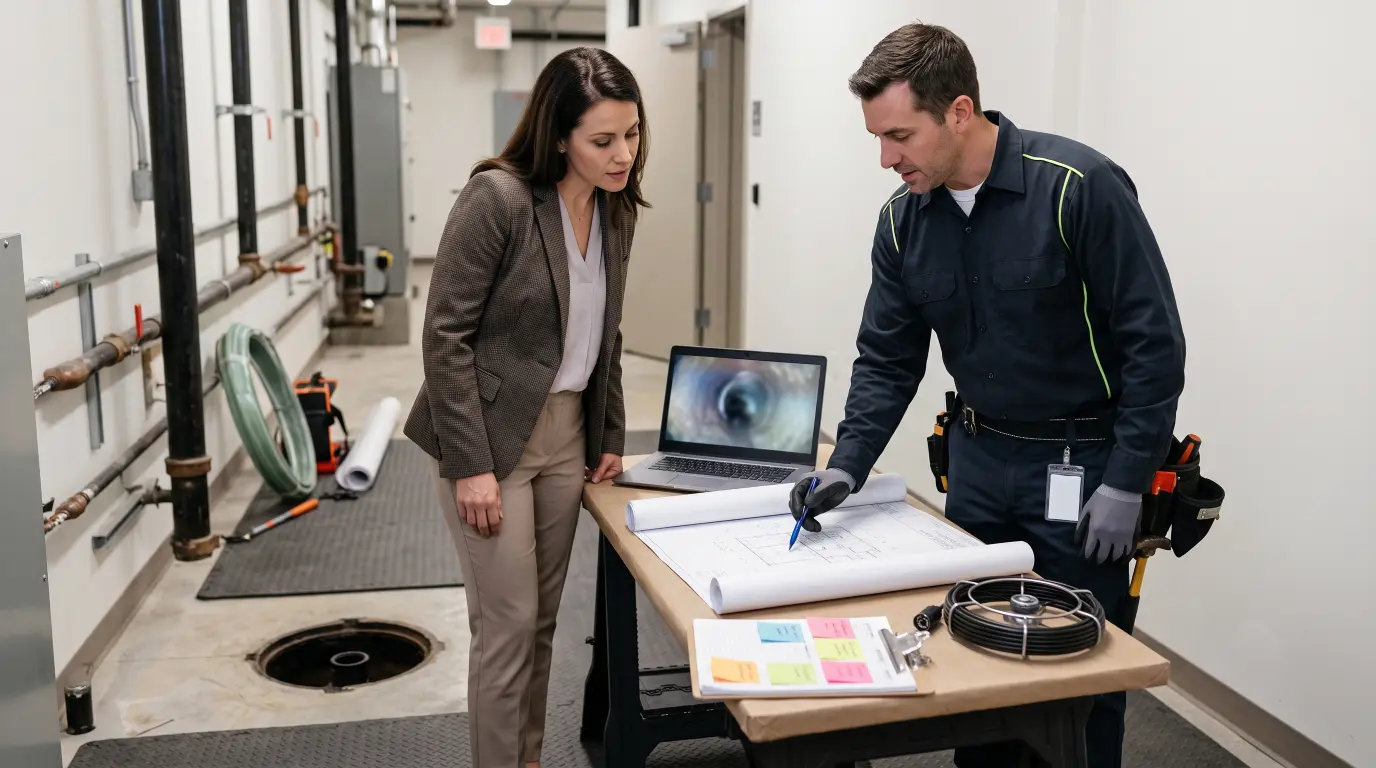
A camera inspection is usually one of the first steps in evaluating pipe lining for apartment building drains, commercial kitchens, office buildings, and other occupied properties. The camera helps identify cracks, corrosion, root intrusion, buildup, offsets, standing water, broken sections, and access limitations.
The inspection should also help map the line. Property teams need to know where the pipe runs, where it connects, where access points exist, and which areas could be affected by the project.
Ask for a clear explanation of the findings. A good contractor should be able to show what was observed, explain what it means, and identify whether additional cleaning, measurement, or investigation is needed before a lining recommendation can be made.
Can You Line a Cast Iron Drain Pipe in a Commercial Building?
Many commercial properties and older multifamily buildings have cast iron drain lines. In some cases, cast iron may be a candidate for lining, especially when the pipe is corroded, scaling, cracking, or showing repeated clog patterns but has enough structure to support rehabilitation.
The answer depends on condition. The pipe may need descaling, cleaning, video inspection, and assessment before lining is considered. If the cast iron is too deteriorated, collapsed, or poorly aligned, lining may not be the best solution.
Property managers should avoid a yes-or-no assumption. The better question is: what does the camera inspection show, and does the pipe condition support a lined repair path?
Access Points Matter More Than Most Teams Expect
Access points are one of the most important planning factors in commercial pipe lining. A contractor needs a way to inspect, clean, prepare, insert, and cure the liner. Existing cleanouts, roof access, floor drains, mechanical rooms, restrooms, and tenant-area access can all affect the plan.
Limited access can add complexity. If the only entry point is inside an occupied tenant space, the schedule may need to be coordinated carefully. If access is blocked by equipment, finishes, storage, or security restrictions, the project team may need to create a safe and workable staging plan.
Before approving a project, ask where the contractor will enter the line, where equipment will be placed, which rooms or areas will be affected, and whether any access improvements are needed.
Scheduling Around Tenants and Building Operations
One of the main reasons property managers compare pipe lining vs excavation downtime is scheduling. A trenchless approach may reduce disruption, but it still requires planning. Tenants may need advance notice. Restrooms or drains may need to be temporarily out of service. Certain areas may need to be protected or cleared.
The project schedule should account for inspection, cleaning, prep, lining, curing, reinstatement where applicable, final inspection, and cleanup. For commercial properties, this may need to happen after hours, over a weekend, during a low-traffic period, or in phases.
Ask how long each affected line may be out of service and what tenants should avoid during the work. Clear communication helps prevent accidental water use, drain use, or access conflicts during the project.
Understanding the Commercial Drain Pipe Lining Process
The commercial drain pipe lining process varies by property and system, but many projects follow a similar sequence. The contractor inspects the line, cleans and prepares the pipe, confirms measurements, selects the lining approach, installs the liner, cures it, opens branches or connections where needed, and verifies the completed work.
Cleaning and preparation are critical. A liner should not be installed over heavy scale, grease, debris, roots, or unstable material without proper preparation. The quality of the final result depends heavily on the preparation and inspection process.
Property teams should ask what steps will be documented, what photos or video will be provided, and how the contractor confirms the finished liner is properly placed.
Quality Controls to Ask About
Quality controls help protect the property team from approving a project blindly. Ask whether the contractor provides pre-lining and post-lining video, how the pipe is cleaned, how measurements are confirmed, how curing is monitored, and how branch lines or reinstatements are handled.
Also ask what product or lining system is being used, what types of pipe it is intended for, what limitations apply, and what warranty or workmanship information is available for the specific project.
Good quality control does not mean every project is risk-free. It means the contractor has a disciplined process for confirming conditions before and after the work.
Tenant Communication and Service Interruption Planning
For multifamily, office, retail, and mixed-use buildings, tenant communication is part of the repair plan. Property teams should know who will be affected, what drains or fixtures cannot be used, when work begins, when service is expected to return, and whom tenants should contact with questions.
Tenant notices should be clear and practical. Avoid technical overload. Tell people the date, time, affected fixtures, access needs, and any precautions. If work is phased, explain which units or areas are included in each phase.
A trenchless repair can still feel disruptive if tenants are surprised. Communication is one of the easiest ways to reduce frustration.
Pipe Lining vs Excavation Downtime
Excavation can be necessary and appropriate, especially when a pipe is collapsed, severely misaligned, or not a lining candidate. But excavation often creates more visible disruption. It may involve cutting concrete, trenching, removing finishes, restoring flooring, coordinating multiple trades, and closing areas of the building.
Pipe lining may reduce those impacts when the line is a fit. Instead of exposing the full pipe route, the contractor may work from access points and rehabilitate the line from inside. That can be valuable in occupied buildings where downtime, noise, dust, and tenant disruption matter.
The comparison should be made project by project. A trustworthy contractor should explain why lining, excavation, spot repair, or another approach is recommended for the specific line.
Budgeting Beyond the Repair Invoice
Property teams should consider total cost, not just the repair proposal. Excavation may involve restoration, tenant disruption, lost use of space, temporary facilities, after-hours labor, additional trades, and extended downtime. Lining may involve inspection, cleaning, access preparation, specialized equipment, and coordination, but it may reduce some restoration costs when it fits.
The best budgeting conversation includes both direct and indirect costs. What areas will be affected? How long will service be interrupted? Are there tenant concessions, business interruptions, cleanup costs, or restoration costs to consider?
No responsible contractor should promise universal savings. The goal is to compare realistic scenarios based on the building’s actual conditions.
Contractor Questions to Ask Before Approving Pipe Lining
Before choosing a pipe lining contractor, property managers should ask direct questions. What does the camera inspection show? Why is this line a candidate for lining? What are the access points? What cleaning is required? What is the expected service interruption? What areas of the building will be affected?
Also ask what lining system will be used, how curing is handled, whether pre- and post-work videos are provided, what limitations exist, how branch connections are reopened, and what documentation the property team will receive.
These pipe lining contractor questions to ask can reveal whether the contractor is diagnosing the problem carefully or simply selling the method.
Red Flags During the Evaluation
Be cautious if a contractor recommends lining without inspection, minimizes tenant disruption without explaining the schedule, avoids discussing limitations, cannot explain access needs, or refuses to provide clear documentation.
Other red flags include vague proposals, unclear warranty language, pressure to approve immediately, no plan for tenant communication, no discussion of line cleaning, and no explanation of why excavation is or is not needed.
Commercial pipe rehabilitation is too important for shortcuts. A good fit assessment should feel specific to the building, not generic.
How Daniel’s Plumbing Services Supports Commercial Pipe Lining Planning
Daniel’s Plumbing Services serves metro Atlanta homes and businesses with plumbing service, repair, installation, and specialty solutions. Its trenchless pipe repair offering includes NuFlow NuDrain CIPP pipe lining for drains, sewer, storm water, and roof drains, positioned as a way to reduce disruption compared with traditional replacement when the line is a suitable candidate.
For commercial properties, Daniel’s Plumbing Services can help evaluate recurring backups, inspect problem lines, review access points, explain repair options, and help property teams understand whether pipe lining should be considered.
Not every line can or should be lined. Daniel’s Plumbing Services cannot guarantee suitability, downtime reduction, cost savings, or outcomes without inspection and project-specific review. But for property managers dealing with repeated drain issues, a professional evaluation is the right next step.
Commercial Pipe Lining Fit Checklist
Use this checklist before approving a trenchless pipe rehabilitation project:
The property has recurring backups, leaks, corrosion, root intrusion, or aging drain lines.
The affected pipe has been inspected with a camera.
The contractor can explain the cause of the problem.
The host pipe appears structurally suitable for lining, subject to professional evaluation.
Access points are identified and workable.
Cleaning and preparation requirements are clear.
Tenant or occupant disruption is mapped and communicated.
Service interruption timing is documented.
The contractor explains lining vs excavation options.
Pre- and post-lining documentation is included.
Quality controls, curing process, and limitations are explained.
Warranty or workmanship terms are provided in writing.
The property team understands what the repair can and cannot solve.
Final Thoughts
Commercial pipe lining can be a valuable option for property managers who need to address recurring drain problems while reducing demolition and downtime. It is especially worth evaluating when lines are under slabs, tenant spaces, finished floors, or other high-disruption areas.
But pipe lining is a fit-based solution, not a universal answer. The line condition, access points, schedule, tenant impact, and quality controls all matter.
If tenants are complaining about repeated backups or your facility team is tired of temporary fixes, Daniel’s Plumbing Services can help evaluate whether commercial pipe lining belongs in the repair conversation.
FAQ
What is commercial pipe lining?
Commercial pipe lining is a trenchless rehabilitation method that creates a new interior pipe surface inside certain existing drain, sewer, storm, or roof drain lines. It may reduce demolition when the host pipe is a suitable candidate.
Can you line a cast iron drain pipe in a commercial building?
Sometimes. Cast iron drain lines may be candidates for lining when they have enough structural integrity and can be properly cleaned and prepared. Severely collapsed, offset, or deteriorated lines may require another repair approach.
How does pipe lining reduce downtime compared with excavation?
Pipe lining may reduce downtime by working through existing access points instead of exposing the full pipe route through demolition or trenching. Actual downtime depends on line condition, access, cleaning, curing, tenant coordination, and project scope.
What should property managers ask a pipe lining contractor?
Property managers should ask about camera inspection findings, pipe condition, access points, cleaning, lining system, curing method, service interruption, tenant impact, quality controls, post-work video, limitations, and warranty details.
How can Daniel’s Plumbing Services help with commercial drain pipe lining?
Daniel’s Plumbing Services can inspect problem drain lines, evaluate recurring backups, explain trenchless pipe lining options, review access and scheduling needs, and help metro Atlanta property teams decide whether pipe lining is worth considering.
RELATED LINK: