
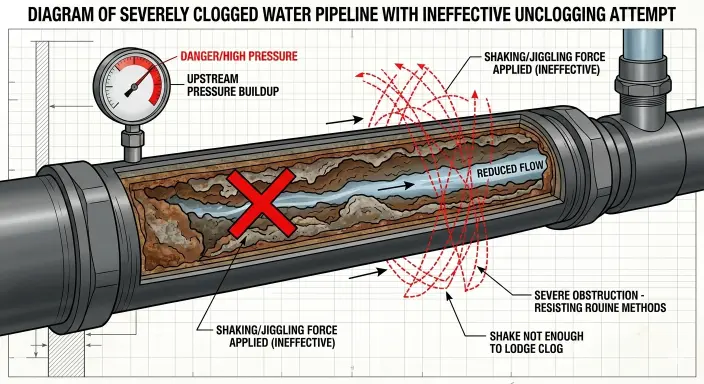
Snaking didn’t fix the clog and it’s still slow a few weeks later, you’re not “doing it wrong”—you may be treating a symptom, not a cause. Some clogs really are a one-time obstruction: a knot of hair, a wad of paper, a small blockage that clears and stays clear.
But a monthly repeat is different. When the same clog returns on a schedule—especially after you’ve snaked it before—it often means the pipe is still narrowing, catching debris, or being invaded by something the snake can’t truly correct. In other words: the drain can drain for a moment, and still not be “fixed.”
This guide will help you understand why snaking sometimes “works” but doesn’t solve the underlying issue, how to tell which failure mode you’re dealing with, and what the next best step usually is when you want the cycle to stop—often starting with inspection.
The real problem: snaking clears a path—sometimes it doesn’t remove the cause
A drain snake is built to break through a blockage and restore flow. In many situations, that’s exactly what you want: it opens a channel so water can get past whatever was stuck.
The part most homeowners don’t realize is that “water went down” doesn’t always mean the line is truly clean.
Snaking often does one of these things:
- Punches a hole through a soft clog so water starts moving again.
- Pulls out a localized obstruction (hair, paper, small debris) if it can grab it.
- Breaks up a blockage enough for it to travel further down the line.
What it often doesn’t do is:
- Strip off buildup clinging to pipe walls (think greasy films, sludge layers, or certain types of residue).
- Correct a pipe defect (a sagging section, a broken or offset joint, a crushed area).
- Stop something from coming back (like roots that will continue to regrow or re-enter).
That’s why recurring clogs are best treated as a pattern, not a one-time event. The pattern is the clue. If you’re dealing with a monthly repeat, the right question is less “How do I snake better?” and more “What’s making this line keep restricting itself?”
Fast triage: 4 questions that tell you if this is “maintenance” or a pipe issue
You don’t need to be a plumber to gather the kind of information that changes the outcome of a service call. Before you pay for “another snake,” answer these four questions as honestly as you can.
Is it one fixture, one area group, or multiple fixtures at once?
This is one of the most useful clues.
- One fixture only (just one sink, one tub) often points to a more localized issue in that branch line or fixture setup.
- One area group (a bathroom group where the sink, tub, and toilet seem connected) can suggest a shared branch line issue.
- Multiple fixtures across the home slowing at once—especially if a toilet bubbles when a sink drains—can point toward a main line problem.
If you’re seeing multiple fixtures affected, that’s usually a sign to think beyond “simple maintenance.”
Does the drain improve for days… or weeks… or only hours?
How long it stays “better” matters.
- Hours to a day: often suggests the line is still heavily restricted; you may have opened a small channel but left a lot behind.
- A week or two: can point to buildup that quickly re-catches debris (common in certain kitchen lines).
- A month: the “monthly repeat” pattern is common when something is consistently re-forming—like roots intruding, a sag collecting solids, or a recurring buildup layer that never gets fully removed.
If the line “works once” and then slowly degrades again, that’s a classic sign that the pipe is still narrowing or collecting.
Is it a kitchen line (grease/food) or a main line (multiple fixtures)?
Kitchen clogs have their own personality. Even if you’re careful, kitchen drains often deal with:
- Grease and oils that cool and cling to pipe walls
- Fine food particles
- Soap residue that can bind with grease
A main line issue often shows up differently:
- Multiple fixtures affected
- Lower-level drains acting up first
- Gurgling or bubbling when other fixtures run
- Backups that can happen during heavy use (laundry + showers + dishwasher)
You don’t have to diagnose it yourself—just notice which “category” your symptoms seem to fit.
Any warning signs—gurgling, sewage odor, slow drains across bathrooms?
These are the signals that your home is telling you, “This is more than a one-off clog.”
Watch for:
- Gurgling when a nearby fixture drains
- Sewage odors that come and go
- Bubbles in a toilet when you run a sink or tub
- Repeated slow drains in multiple bathrooms
- Backups (even small ones) that seem tied to overall water usage
If you’re seeing any of those, it’s usually smarter to shift to diagnosis rather than repeating the same clearing method.
When snaking is the right tool (and what “success” should look like)
Snaking is not “bad.” It’s just not the right tool for every job.
Snaking is often a good fit when:
- It’s a first-time clog
- The problem is localized to one fixture
- You have a clear reason to suspect a simple obstruction (hair, small debris)
- The line has been functioning normally for a long time and suddenly slows
In those cases, success should look like more than “the water went down.”
A better definition of success is:
- The fixture drains normally over time, not just in the moment
- The drain handles typical daily use without gradually slowing again
- There’s no new gurgling, bubbling, or odor after the line is cleared
- The symptom doesn’t return on the same schedule
From a homeowner standpoint, you can observe the basics: drain speed, odors, and whether other fixtures are impacted.
From a plumber’s standpoint, “success” is tied to whether the line is clean enough to stay open—or whether the cause is still present. If the clog returns predictably, it’s often a sign that snaking delivered temporary relief, not true resolution.
When snaking won’t fix it: the most common “recurring clog” causes
Recurring clogs are frustrating because they feel like the problem is “almost solved.” But the repeat is the clue that something persistent is at play.
Here are the most common causes behind the monthly cycle.
Root intrusion (how it behaves; why it returns)
Roots are drawn to moisture. If there’s a pathway—such as a small opening at a joint—roots can find it and begin to intrude.
What it often looks like in real life:
- The line clears, then clogs again on a schedule
- You may notice issues during heavy water use
- In some cases, symptoms appear in multiple fixtures, depending on where the intrusion is
A snake can sometimes cut through roots enough to restore flow. But if roots are present, the underlying condition hasn’t changed—so the problem can return. That’s why recurring main line issues often prompt inspection: you want to confirm whether roots are involved and how severe the intrusion is.
Pipe belly / sag (why flow slows and debris settles)
A “belly” is a low spot in the pipe where water doesn’t drain properly. Instead of flowing smoothly, it can hold standing water.
Why that matters: if a section holds water, it can allow solids and debris to settle more easily. Even if you clear a blockage, the low spot can continue to collect material, and the clog re-forms.
Common homeowner clues can include:
- Slow drains that worsen over time, even after clearing
- Repeat clogs that seem tied to normal use
- Symptoms that return without any obvious “cause event”
A pipe belly is difficult to confirm without inspection, which is why recurring clogs in a predictable pattern often lead to a camera recommendation.
Grease buildup and sludge layers (kitchen patterns; why chemicals fail)
Kitchen drains are notorious for recurring slowdowns because grease doesn’t behave like a solid object you can “pull out once.”
Grease can coat pipe walls, narrowing the interior over time. Then normal debris—small food particles, soap residue—sticks to that layer. Snaking may open a channel down the middle while leaving the walls coated, which can explain why the line feels better briefly and then slows again.
Chemical drain openers and “enzyme” products can be inconsistent in real-world conditions. Even when they seem to help, they often don’t address the deeper issue if the line is heavily coated or if there’s a physical defect contributing to buildup.
Scale or rough interior surfaces (older piping)
In some older systems, pipe interiors can become rougher over time due to material condition, corrosion, or mineral-related buildup. A rough interior can catch debris more easily, which makes “normal use” more likely to lead to repeat slowdowns.
You don’t need to label the material or guess the cause. The practical point is this: if the inside of the pipe isn’t smooth and clear, it can behave like a net—catching buildup again and again.
The misconception reversal: “It drained, so it’s solved” is how repeat clogs get expensive
It’s completely reasonable to think: “The water is going down. The problem must be fixed.”
The issue is that many recurring clogs allow water to drain through a temporary channel. That channel can give a false sense of security while the pipe remains restricted.
This is how repeat clogs become expensive—not because one service call was wrong, but because the same approach is repeated without confirming the cause.
The hidden cost shows up as:
- Multiple appointments for the same symptom
- The inconvenience of waiting until it gets bad again
- Increased risk of a backup (especially during heavy use)
- The stress of not knowing whether something bigger is brewing
If the same clog returns monthly, the smartest move is often to switch from “clearing” mode to “confirmation” mode.
The next step that changes the outcome: camera inspection after a repeat clog
A camera inspection is often the turning point for recurring drain problems because it replaces guesswork with evidence.
A sewer or drain camera can help reveal:
- Root intrusion
- A sagging section (belly)
- Offsets, breaks, or damaged areas
- Heavy buildup or a narrowed line
- Where the issue is located (which matters for choosing the right fix)
You don’t need a camera for every slow drain. But it becomes more reasonable when the pattern suggests the problem isn’t a one-time blockage.
A few trigger-based moments when many homeowners ask for inspection:
- The same clog returns monthly
- Multiple fixtures are affected
- You’ve had a backup (even a minor one)
- Snaking helped briefly and then stopped working
- You’re tired of repeating the same service with the same results
What “good findings” versus “bad findings” mean is less about fear and more about clarity.
- A “good” finding might be: localized buildup that can be properly cleaned, with no structural defects.
- A “bad” finding might be: ongoing intrusion, a clear defect, or a section of pipe that can’t drain correctly.
Either way, knowing what you’re dealing with helps you choose the least disruptive option that actually fits the problem.
Options that actually stop the cycle: cleaning, jetting, and rehabilitation (decision logic)
Once you know why the clog is recurring, the solution becomes much more straightforward. The goal isn’t to jump to the biggest fix. It’s to match the method to the condition.
When drain cleaning / descaling is the right move
If the issue is primarily buildup—especially in a line that’s otherwise structurally sound—thorough cleaning can be the right path.
The key idea is “thorough.” A quick channel through the center may not be enough if the pipe walls are coated and narrowing the line.
Because pipe materials and conditions vary, the right approach should be based on what’s found (or strongly suspected) and what the pipe can safely tolerate. If the condition is unknown, inspection can help guide this.
When hydro jetting can help (where appropriate)
Hydro jetting is often used to clean certain lines more thoroughly than snaking. It’s commonly discussed for greasy kitchen lines and buildup problems.
But suitability depends on pipe condition and material. If a line is damaged or fragile, aggressive cleaning can be the wrong fit. That’s why a professional should confirm whether jetting is appropriate—especially in older systems or when you suspect defects.
A simple rule of thumb: if you’re considering a more forceful cleaning method, it’s worth confirming the line can handle it.
When lining (CIPP/pipe-within-a-pipe) becomes the best fit for recurring defects
If the camera shows a recurring defect—like a compromised section that contributes to repeat clogs—rehabilitation can become the more logical path.
CIPP (cured-in-place pipe) lining is often described as a “pipe-within-a-pipe” method. It can be an option in certain cases where the existing pipe is a candidate for rehabilitation rather than full replacement.
The important part is the condition check: lining isn’t for every situation, and it’s not a “magic fix.” It’s a tool for specific types of pipe problems when inspection confirms it’s appropriate.
What replacement is usually reserved for
Replacement is generally considered when there are structural failures that can’t be addressed by cleaning or rehabilitation, or when access and layout make other options unrealistic.
The idea isn’t to scare anyone into replacement. It’s to be honest: some conditions require a more direct repair path. The reason diagnosis matters is that it helps you avoid unnecessary disruption when a less invasive option is available—and it helps you act decisively when it’s not.
What to tell your plumber (so you get a real plan, not another temporary fix)
If you want a real plan, the most helpful thing you can do is give a clear history. The more specific your story, the faster a plumber can narrow the likely causes.
Here’s what to share:
- How often it returns (monthly, weekly, every few days)
- What was tried (hand auger, professional snake, chemicals, enzyme products)
- Which fixtures are affected (one sink vs multiple fixtures)
- Whether it improves for hours, days, or weeks
- Any warning signs (gurgling, odors, bubbles in toilet, minor backups)
- Any “starting event” (renovation, tree growth, heavy grease use, recent plumbing work)
If you can do it safely, you can also take:
- A short video showing the slow drain behavior
- A photo under the sink if there’s visible leaking or corrosion
- A photo of any accessible cleanout area (if you know where it is)
And here are questions that can steer the conversation toward a real resolution:
- “What do you think is causing the recurrence?”
- “Would a camera inspection help confirm it?”
- “What would you need to see to recommend a different approach?”
- “If we clear it today, what’s the plan to prevent the next repeat?”
Those questions aren’t confrontational—they’re practical. They signal that you’re not just paying for a temporary reset. You want the cause identified.
Stop the monthly clog cycle—starting with diagnosis
If the same clog keeps coming back, you shouldn’t have to keep paying for the same temporary fix. The fastest path to a better outcome is usually diagnosis-first: confirm whether you’re dealing with buildup, roots, a sagging section of pipe, or a damaged area that keeps catching debris.
Daniel’s Plumbing Services can help you move past the guessing. If it’s a cleaning problem, you want the right level of cleaning. If it’s a pipe problem, you want to know early—before a slow drain turns into a weekend backup.
Call Daniel’s Plumbing Services or click Make Appointment to stop the monthly clog cycle.
FAQ content
1) Why is my drain still slow after snaking?
Snaking can restore flow by opening a channel through a blockage, but it may not remove buildup stuck to the pipe walls or fix a pipe defect. If the line is still narrowed, it can remain slow or quickly become slow again.
2) Snaking the drain helped—why did the clog come back?
A recurring clog usually means the underlying cause is still present—such as grease buildup, root intrusion, a sagging section of pipe, or a damaged area that keeps catching debris. Snaking can bring temporary relief without changing the condition that makes clogs return.
3) What are signs of roots in a sewer line?
Some common signs include recurring clogs that return on a schedule, symptoms that affect multiple fixtures, and backups that happen during heavier water use. A camera inspection is typically the clearest way to confirm whether roots are involved and where they’re entering.
4) When should I get a camera inspection after a clog?
It’s often worth considering when the clog returns monthly, when multiple fixtures are affected, when you’ve already snaked the line more than once, or if you’ve experienced a backup. Inspection helps confirm whether the issue is buildup or a pipe defect.
5) When is hydro jetting a better option than snaking?
Hydro jetting can be useful when the problem is stubborn buildup—often in lines where residue coats the pipe walls—because it may clean more thoroughly than snaking. Whether it’s appropriate depends on the pipe’s condition and material, so a professional should confirm it’s a safe fit.
6) Can pipe lining fix recurring clogs without replacing the pipe?
In some cases, yes. If inspection shows defects that contribute to recurring clogs and the pipe is a good candidate, lining (CIPP/pipe-within-a-pipe) may rehabilitate the line without full replacement. A camera inspection typically determines whether lining is appropriate.
If the same clog keeps coming back, you shouldn’t have to keep paying for the same temporary fix. We’ll start with the right diagnosis—often a camera inspection—to confirm whether it’s roots, buildup, a sag, or a damaged section of pipe. Then you’ll get clear options: cleaning, jetting where appropriate, or trenchless rehabilitation when it’s the best fit. Call Daniel’s Plumbing Services or click Make Appointment to stop the monthly clog cycle.
Not sure if it’s a kitchen line issue or a main line warning sign? Call now and tell us what’s happening—how often it returns, which fixtures are affected, and whether you’ve noticed gurgling, odors, or backups. We’ll help you figure out the next best step.