
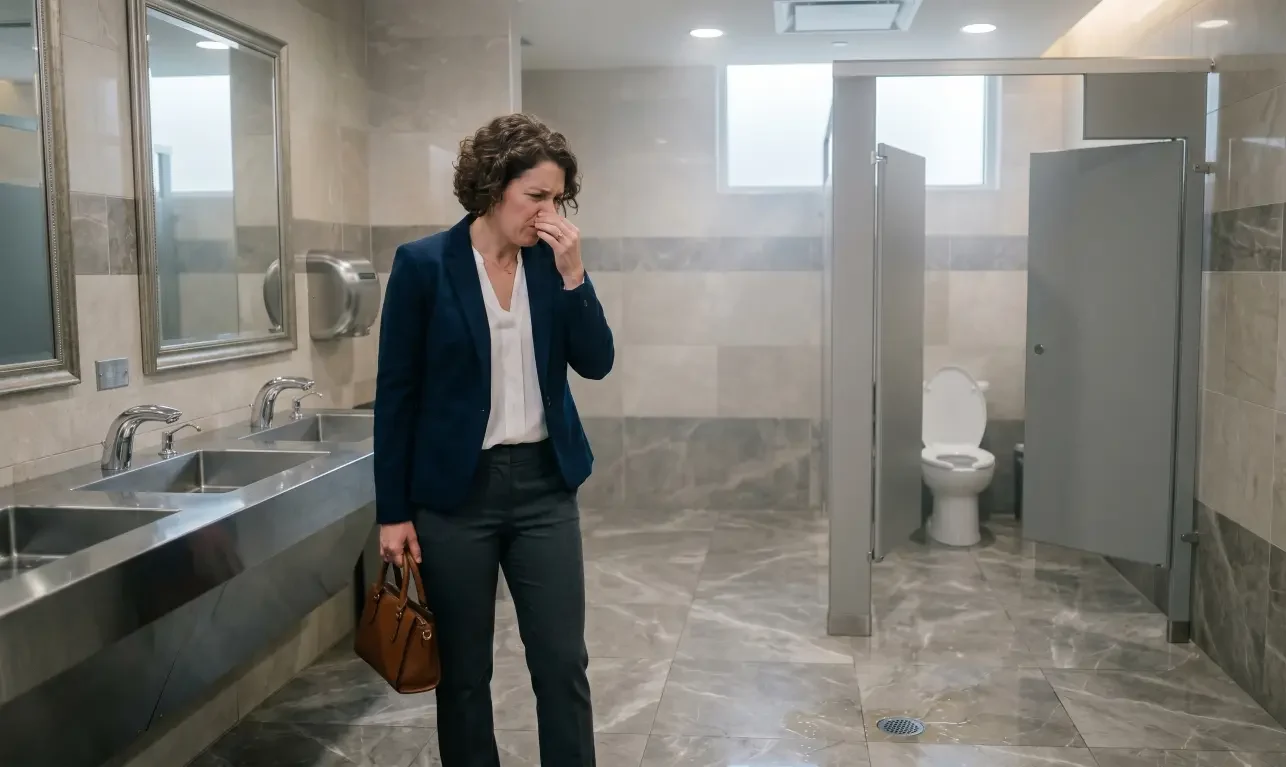
You get the complaint email: “Restroom smells like sewer again.”
It is not constant. It is not obvious. And it is not something your tenants, staff, or customers are going to ignore for long.
For property managers and facility managers, this is one of the more frustrating plumbing problems to deal with because it rarely behaves like an obvious failure. A restroom may smell fine during the day, then trigger complaints first thing in the morning. One floor may be affected while another is not. Cleaning helps for a few hours, but the odor comes back.
In many cases, sewer odor in a commercial restroom is not a sign of a major line failure. It is often the result of a smaller plumbing issue that only becomes noticeable under certain conditions, especially after hours, during low usage, or in areas with intermittent occupancy.
The good news is that these problems can usually be narrowed down systematically. The goal is not to guess. It is to identify the most likely cause, rule out temporary surface fixes, and address the problem in a way that protects the customer experience without forcing a shutdown.
Lets find out what causes sewer odor in a commercial restroom
Why Sewer Odor in Commercial Restrooms Is So Hard to Pin Down
A persistent leak is easier to understand. A clogged toilet is easier to see. Sewer odor is different because it can appear, disappear, and shift depending on how the building is being used.
That is what makes it so difficult in commercial settings. A restroom in a busy restaurant behaves differently from one in an office suite that sits empty overnight. A floor drain in a back-of-house utility area may go unused for days, while sinks and toilets nearby stay active. In a retail space, staff may notice the smell before opening, but by lunchtime the odor seems to fade.
This inconsistency leads a lot of teams toward the wrong fixes. The first response is usually more cleaning, stronger deodorizing products, or a one-time drain treatment. Those steps may cover the smell for a short period, but they do not address the underlying reason sewer gas is entering the space.
It also helps to separate odor from a true sewer backup. If you are seeing wastewater backing up, slow drainage across multiple fixtures, or obvious overflow, that points to a different level of problem. Sewer odor can happen without any visible backup at all. In many commercial buildings, the issue is not that waste is not moving. It is that a water seal, pressure balance, or supporting component is no longer doing its job consistently.
That is why the best first step is not “fix everything.” It is figuring out what kind of odor problem you actually have.
The 3 Most Common Causes (and How to Tell Which One You Have)
If sewer odor shows up in a commercial restroom, three causes tend to come up again and again: dry or compromised drain traps, trap primer problems, and venting issues.
These are not the only possibilities, but they are a strong place to start because they match the way most intermittent odor complaints behave. They are especially relevant when the smell comes and goes, appears after hours, or affects floor drains and low-use restrooms more than heavily used ones.
A simple way to think about the triage is this:
If the odor is strongest near a floor drain or in a restroom that does not get much daily use, look at the trap first.
If the building has floor drains that are supposed to stay wet automatically, and the problem keeps returning even after water has been added, a trap primer issue becomes more likely.
If the smell is harder to isolate, changes with usage or weather, or seems to move between fixtures or spaces, venting may be part of the problem.
The key is not to jump straight to the most expensive explanation. Start with the simplest system that is supposed to block sewer gas from entering the room.
Cause #1 — Dry or Compromised Drain Traps
A drain trap is one of the most basic odor-blocking components in the plumbing system, but it is also one of the easiest to overlook.
Every properly trapped drain is designed to hold a small amount of water. That water creates a seal between the restroom and the sewer system. When the seal is intact, odors stay in the piping where they belong. When the seal is lost or weakened, sewer gas can enter the room.
Why floor drains smell in low-use areas
This is one of the most common reasons a floor drain smells in a business.
In commercial buildings, some drains simply do not get enough regular use to maintain that water seal. Think of a floor drain in a janitor closet, a restroom in a vacant suite, a rarely used employee bathroom, or a restroom that sees very light traffic after hours. If water is not moving through that drain often enough, the trap can dry out over time.
That is why complaints often show up in the morning or after a weekend. The building has been quiet, the restroom has not been used much, and the trap has had time to lose enough water for odor to escape.
The frustrating part is that someone may pour water down the drain, the smell goes away, and everyone assumes the problem is solved. Then a few days later, the odor is back. That points to an ongoing condition, not a one-time event.
How traps lose their water seal (evaporation, siphoning)
Low use is one reason a trap loses its seal, but it is not the only one.
Evaporation is the most straightforward explanation. In a drain that sees very little water flow, the trap can gradually dry out. This is common in buildings with intermittent occupancy, in seasonal commercial spaces, or in restrooms that are technically active but not used enough to keep all drains wet.
The other issue is trap compromise. In simple terms, the trap may not be holding water the way it should. Sometimes that is due to pressure changes in the system. Sometimes it is related to the way nearby fixtures drain. The result is the same: the barrier between the room and the sewer line becomes unreliable.
What matters for a property manager is not diagnosing the plumbing mechanics in perfect detail. It is recognizing that “we added water once” is not the same thing as “the trap is functioning properly.”
Quick check property managers can do
If odor complaints are tied to a specific restroom, start close to the floor.
Check whether there is a floor drain, mop sink, or other infrequently used drain in or near the affected area. If there is, note whether the odor seems strongest near that point. In a low-use restroom or service area, that is a meaningful clue.
You can also look for a pattern. Does the smell show up after weekends, overnight, or during periods of low traffic? Does it improve after cleaning or after the restroom has been used more heavily? Those details can support the dry-trap theory without requiring guesswork.
What you want to avoid is treating this as a solved problem just because water temporarily reduced the smell. If the issue returns on a pattern, the next question is why the trap is not staying protected.
Cause #2 — Trap Primer Problems (The Hidden System Most People Miss)
In many commercial buildings, some floor drains are not expected to rely on occasional use alone. They may be supported by a trap primer, which is designed to help maintain water in the trap.
This is where a lot of odor investigations stall. The visible drain gets attention, but the hidden support component does not.
What a trap primer does in commercial buildings
A trap primer is generally intended to help keep water in a drain trap, especially where regular drain use is not guaranteed.
That matters in commercial settings because not every floor drain is in a location that gets daily flow. A floor drain may exist for code, maintenance, or overflow reasons rather than for constant use. Without some way to keep the trap seal intact, that drain can become a recurring odor source.
For a facility manager, the practical takeaway is simple: some drains are supposed to stay protected automatically. If they are not, the problem can keep coming back no matter how often someone tops them off manually.
Signs a trap primer isn’t working
The most obvious sign is recurrence.
If a floor drain smells, someone adds water, the odor disappears, and then the same drain smells again later under similar conditions, that can point to a primer issue. The same is true if one drain repeatedly has problems while others do not, especially in a commercial restroom or adjacent service area that is lightly used.
Another sign is timing. If the complaint pattern is heavily tied to overnight hours, weekends, or low-traffic periods, that suggests the trap is not staying sealed when building activity drops.
You may also notice that routine cleaning does not change the pattern. The room may look spotless, but the odor keeps returning because the issue is not surface contamination. It is the loss of the water barrier in the plumbing system.
For many managers, the challenge is that trap primers are out of sight and out of mind until a smell starts affecting the space.
Why this issue shows up after hours
After-hours complaints are often what finally push this issue to the top of the list.
During the day, buildings are active. Fixtures are used. Doors open and close. Air movement changes. Restroom traffic can mask or dilute an odor pattern. But once the building quiets down, that intermittent sewer gas smell may become much more noticeable.
This does not necessarily mean the problem only exists at night. It may simply be easier to detect when usage drops and the trap seal is no longer being replenished or supported the way it should be.
That is why “the restroom smells fine when the plumber arrives” is such a common frustration. The complaint is real. The timing is just part of the diagnosis.
Cause #3 — Venting Issues That Let Sewer Gas Escape
When drain traps and primers do not fully explain the problem, venting becomes the next major area to consider.
A plumbing system is not only about moving water out. It also depends on proper airflow and pressure balance. When that balance is disrupted, sewer odor can show up in ways that feel inconsistent or difficult to trace.
How venting is supposed to work
In general, venting helps a plumbing system drain properly while limiting the pressure problems that can affect traps and allow odors to escape.
The easiest way to think about it is this: fixtures need more than a path for wastewater. They also need the plumbing system to breathe. When venting is working as intended, drains and traps are less likely to experience the kinds of pressure changes that interfere with the water seal.
That may sound technical, but the operational impact is straightforward. Good venting supports stable performance. Poor venting can create odd, intermittent symptoms that do not always look like a classic clog or leak.
What happens when vents are blocked or undersized
When venting is restricted, the system may not handle air and pressure the way it should. That can contribute to odor problems without creating a dramatic failure.
In a commercial building, this may present as a smell that seems to shift with fixture usage, occupancy patterns, or certain times of day. One restroom may be the place where the odor is noticed, but the root issue may not be isolated to that exact fixture.
This is one reason surface-level fixes often fall short. If the real issue involves venting, stronger cleaning chemicals, drain fresheners, or repeated manual refilling of a trap may only reduce the symptom temporarily.
It is also why vent-related issues are harder for on-site staff to confirm quickly. Unlike a dry floor drain, the problem is not always visible at the point where the complaint is made.
Why smells “come and go” with pressure changes
This is where many intermittent odor complaints start to make more sense.
If sewer gas is escaping because the system’s pressure balance is inconsistent, the smell may not be constant. It can become more noticeable at some times than others depending on building use, fixture activity, air movement, and how the plumbing system is behaving in that moment.
That “comes and goes” pattern is important. It often leads people to dismiss the complaint because the smell is not always present. In reality, inconsistency can be part of the symptom profile. The absence of a constant odor does not mean there is no plumbing issue to address.
The Contrarian Reality: It’s Often Not a “Major Sewer Problem”
When a restroom smells like sewer, it is easy for everyone involved to jump to the worst-case explanation.
The assumption is that something big has failed. A line must be broken. A major backup must be starting. The fix must involve tearing into walls, shutting down restrooms, or disrupting operations.
Sometimes a larger issue is present. But often, that is not where the problem starts.
In many commercial restrooms, odor complaints are tied to smaller imbalances in the plumbing system rather than a catastrophic sewer failure. A trap has dried out. A primer is not doing its job. Venting is contributing to odor release under certain conditions. None of those are minor from an experience standpoint, but they are different from a full-scale sewer emergency.
That distinction matters because overreacting can create its own problems. If the first assumption is “this must be a huge sewer issue,” the response may become more disruptive than necessary. Areas get shut down prematurely. Staff spend time chasing the wrong cause. Budget attention goes to the most dramatic possibility instead of the most likely one.
A better approach is to treat the odor seriously without treating it automatically as a major system failure. Serious does not always mean severe. In building operations, the most effective response is often the one that narrows the issue quickly and targets the actual cause.
Common Mistakes That Make Odor Problems Worse
When restroom odors keep coming back, the same missteps tend to show up again and again.
One common mistake is over-cleaning instead of diagnosing. Cleaning matters, of course. But if the smell is coming from the plumbing system, no amount of deodorizer is going to resolve the underlying issue. At best, it covers the symptom. At worst, it delays real investigation because the room smells better for a short time.
Another mistake is ignoring floor drains and low-traffic drains altogether. In a commercial restroom, people focus on toilets, sinks, and visible fixtures. Floor drains do not get the same attention, especially if they are tucked into corners or adjacent service areas. Yet those drains are often the source of intermittent odor complaints.
A third mistake is assuming a temporary improvement means the problem is solved. Pouring water into a drain may reduce odor. That is useful as a clue. It is not proof that the issue is gone for good. If the smell comes back on a pattern, the system still needs attention.
It is also a mistake to treat the complaint as random because it is inconsistent. Intermittent does not mean imaginary. If multiple tenants, staff members, or customers are noticing the odor at similar times, that pattern is worth documenting.
Finally, many teams wait too long to escalate because there is no visible backup. That is understandable. Odor alone can feel less urgent than an active flood or stoppage. But from a customer experience standpoint, a recurring sewer smell in a commercial restroom is already affecting the building. It does not need to become a larger plumbing event before it deserves a proper diagnosis.
A Simple Step-by-Step Triage Checklist (Before You Call for Service)
Before you bring in outside help, it is worth doing a short, practical review. Not because you should solve the issue alone, but because a few details can make the diagnostic process faster and more targeted.
Start by identifying exactly where the odor is strongest. Is it limited to one restroom, one floor, or one part of the building? Is it strongest near a floor drain, sink, toilet, or back-of-house area?
Next, look at usage patterns. Does the smell appear after hours, first thing in the morning, after weekends, or during periods when the space is lightly occupied? That timing matters. A restroom odor after hours often points in a different direction than one that appears only during peak demand.
Then check for low-use drains. Floor drains, mop sinks, and service drains are common odor sources in commercial spaces, especially in offices, retail units, and utility areas that do not get steady daily use.
After that, note whether one fixture or multiple fixtures seem involved. If the odor appears isolated to a single drain area, that supports a more local issue. If multiple drains or rooms seem affected, the problem may be broader.
You should also pay attention to recurrence. Has someone already added water to the drain? Did the smell improve? If so, how long did that improvement last? A short-lived fix can be one of the most useful clues you gather.
If restroom odors are affecting your tenants or customers, it’s worth getting a clear diagnosis—not just another temporary fix.
Our team works with commercial properties across Atlanta to pinpoint the source quickly and resolve it with minimal disruption.
Call Daniel’s Plumbing Services or request an appointment to get it handled.
When It’s Time to Bring in a Plumbing Professional
There is a point where triage stops being useful and professional diagnosis becomes the more efficient path.
If multiple fixtures or rooms are affected, it makes sense to escalate. The same is true if the odor keeps returning even after traps have been refilled or obvious low-use drains have been checked.
You should also bring in a plumbing professional if venting seems likely, if the source is unclear, or if the smell is creating operational pressure from tenants, customers, or staff. In those cases, speed matters not only for the building system but for the people using the space.
For commercial properties, the value of professional service is not only technical skill. It is also the ability to narrow the issue without turning a diagnostic visit into unnecessary disruption. A well-run inspection should help distinguish between a local drain problem, a trap primer issue, and a broader system concern.
That is especially important in buildings where access, business hours, and customer experience all need to be protected. The right next step is not always a major repair. Sometimes it is simply getting the right eyes on the problem before more time is lost on temporary fixes.
Fixing Sewer Odor Without Shutting Down Your Business
Most property managers are not just asking, “What is causing the smell?” They are also asking, “How do we deal with this without making the building harder to operate?”
That is a fair concern. In commercial settings, even minor restroom issues can create outsized disruption if the response is poorly handled. Tenants get frustrated. Customers notice. Staff lose confidence that the issue is under control.
The good news is that sewer odor problems often can be approached in a targeted way. If the issue is tied to a dry trap, the focus is restoring and maintaining the water seal. If a trap primer is not functioning properly, the goal is to correct that support system rather than repeatedly treating the symptom. If venting is involved, the work starts with identifying where the pressure or airflow problem is affecting the system.
The important point is that diagnosis drives efficiency. When the cause is identified clearly, the solution is more likely to be limited, deliberate, and less disruptive than a guessing-based approach.
That matters in offices with after-hours complaints, in restaurants where restroom odor affects guest perception, and in retail spaces where one recurring smell can shape how the whole property feels. A calm, specific response protects both the plumbing system and the building experience.
If the odor issue keeps returning, it is worth moving beyond temporary masking and toward a proper fix. That usually saves more disruption than it creates.
If restroom odors are affecting your tenants or customers, it’s worth getting a clear diagnosis—not just another temporary fix.
Our team works with commercial properties across Atlanta to pinpoint the source quickly and resolve it with minimal disruption.
Call Daniel’s Plumbing Services or request an appointment to get it handled.
FAQ
Why does my commercial restroom smell like sewer only at night?
This often points to a problem that becomes more noticeable during low-use periods. In commercial buildings, odors may show up after hours when a floor drain trap has dried out, a trap primer is not maintaining the seal, or the building is quiet enough for the smell to become more obvious.
What is a trap primer and how do I know if it’s working?
A trap primer is generally designed to help maintain water in certain drain traps, especially in commercial spaces where a floor drain may not get regular use. If a drain smells, improves temporarily after water is added, and then develops the same odor again later, that can be a sign the trap is not staying protected the way it should.
Why do floor drains smell in businesses that aren’t used daily?
Floor drains in low-traffic restrooms, vacant suites, or service areas can lose their water seal over time if they do not get enough regular use. Once that seal is reduced, sewer odor can escape into the room.
Can sewer gas smells be dangerous in commercial buildings?
A recurring sewer odor should be taken seriously, especially in a commercial environment where occupants notice it repeatedly. Even when the issue turns out to be a smaller plumbing problem, it is still worth addressing promptly rather than treating it as only a cleaning issue.
How do you fix sewer odor without closing a business?
The first step is narrowing down the source so the response can be targeted. In many cases, that means checking traps, primers, and venting rather than assuming a major sewer failure. A focused diagnostic process is usually the best way to limit disruption.
Why does the smell come and go instead of staying constant?
Intermittent odor often points to changing conditions in the building or plumbing system. Low usage, after-hours timing, pressure changes, and inconsistent trap sealing can all make sewer smells appear at some times and not others.
If restroom odors are affecting your tenants or customers, it’s worth getting a clear diagnosis—not just another temporary fix.
Our team works with commercial properties across Atlanta to pinpoint the source quickly and resolve it with minimal disruption.
Call Daniel’s Plumbing Services or request an appointment to get it handled.
RELATED LINK:
OSHA — Indoor Air Quality / Workplace Safety