
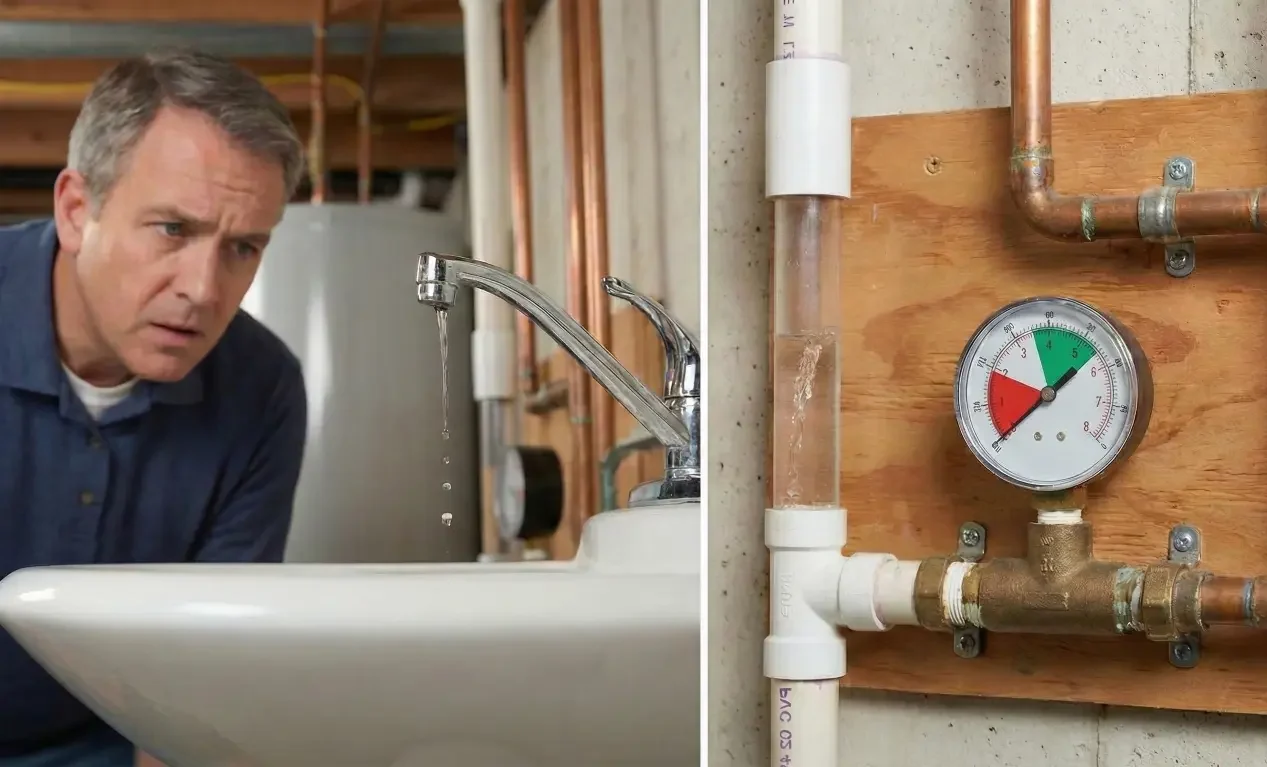
You go to take a shower in the morning and suddenly everything feels weak—sinks, showers, even the outside hose bib. When the whole house’s water pressure dropped overnight, the hard part isn’t noticing it. It’s figuring out whether it’s a city supply issue or a problem inside your plumbing that could get expensive fast.
This guide helps you narrow down why water pressure dropped overnight using simple, safe checks to distinguish supply issues from in-home problems like a pressure regulator (PRV), a partially closed valve, restrictions, or a hidden leak. The goal is to stop guessing and take the right next step.
Overnight pressure drops are different—here’s why it matters
Low pressure that slowly gets worse over weeks often has a different feel than pressure that drops “all at once.” When it happens overnight, you’re dealing with a tighter set of possibilities—and some of them are time-sensitive.
A sudden change can point to:
- Something upstream changing (your neighborhood supply or the city system doing work)
- A single point in your home’s system shifting (like a pressure regulator or a valve)
- A new restriction that wasn’t there yesterday
- In some cases, a leak that started or worsened enough to affect pressure across the house
The key clue in your scenario is “whole-house.” If the pressure feels weak in multiple rooms and multiple fixtures, the cause is often upstream of any one faucet or showerhead. That’s why replacing aerators or blaming one fixture rarely solves an overnight, everywhere-at-once drop.
Start here: confirm what kind of pressure problem you actually have
Before you do anything else, confirm the pattern. The pattern is what tells you whether you’re chasing a house-wide problem, a hot-water-only issue, or something isolated.
Whole house vs one fixture
Walk through a quick check:
- Turn on a bathroom sink, a kitchen sink, and a shower.
- If all of them feel weak, treat it as a whole-house issue.
- If only one fixture is weak, you may be dealing with a clogged aerator, cartridge, or fixture-specific restriction (which is a different problem than this article’s “overnight whole house” trigger).
Cold-only vs hot-only vs both
This matters more than most homeowners realize:
- If cold water is low everywhere but hot feels normal, you could be looking at an issue affecting the cold supply side (or a recent change that impacted cold lines).
- If hot water is low everywhere but cold is normal, your water heater setup or a valve related to it may be involved.
- If both hot and cold are low across the house, that pushes you toward supply/PRV/main-line/valve causes.
Single bathroom vs everywhere
Sometimes the “whole house” feeling is actually “one wing” of the house. If one side is normal and the other is weak, that can suggest a localized restriction, a zone valve issue, or a branch-line problem.
Write down what you observe in one sentence, like:
“Low pressure at every fixture, both hot and cold”
or
“Low pressure only on cold, everywhere”
or
“Only the upstairs bathroom is low; everywhere else is normal.”
That one sentence will save you a lot of time later.
The fast triage checklist (10 minutes, no tools)
This is the part where people want to start taking things apart. Don’t. The fastest path to an answer is observation first, then targeted action.
Check neighbors or the street for supply clues
If you’re in a neighborhood where you can safely and casually ask, a quick “Did your water pressure drop too?” can answer the biggest question: is it just your house?
Also look for non-technical signs that work might be happening nearby—crew trucks, cones, or temporary construction activity. You don’t need to prove anything here. You’re just checking whether a supply event is plausible.
Check multiple fixtures plus an outside spigot for a baseline
If you have an outdoor hose bib/spigot, turn it on briefly.
- If it’s weak too, that supports the idea that the issue is upstream and not just a clogged faucet aerator.
- If the outdoor spigot seems strong but indoor fixtures are weak, you may be dealing with something inside the home (or a restriction affecting indoor plumbing specifically).
Check whether pressure changes when no water is running
Try this simple behavior check:
- Turn on one faucet and feel how weak it is.
- Turn it off for a minute and then turn it on again.
If pressure “surges” briefly and then drops, that can sometimes point to regulation issues or a restriction that behaves differently under flow. It doesn’t diagnose the cause by itself, but it’s a useful clue.
If you can’t tell, don’t worry. The next section gives you the most likely causes and what each one looks like in real life.
Top causes of a whole-house pressure drop overnight
Most whole-house pressure drops boil down to a handful of causes. The goal isn’t to become a plumber in a morning—it’s to match your pattern to the right bucket.
City supply fluctuation or main work
What it can look like:
- Your neighbors notice it too
- It improves later in the day without you touching anything
- Pressure seems inconsistent, not just “low and steady”
A supply issue can happen for reasons outside your control. The practical move is to confirm whether it’s isolated to your home before you start troubleshooting your plumbing system.
PRV (pressure-reducing valve) issues
A PRV is a device that helps regulate the pressure coming into your home. When it drifts or fails, pressure can become too low, inconsistent, or otherwise not what it used to be. (TBD: Confirm specific PRV failure patterns and diagnostic steps for your exact setup.)
What it can look like:
- Whole-house low pressure that doesn’t respond to fixture-level cleaning
- Pressure that feels “fine” at one moment and weak the next
- A change that happens without any obvious work inside the house
A plumber can test and confirm whether a PRV is functioning properly rather than guessing based on symptoms.
Main shutoff partially closed or valve issues
This cause is more common than many homeowners expect, especially:
- After plumbing work
- After a meter replacement
- After someone turned the valve as part of another project and didn’t fully reopen it
What it can look like:
- Pressure is low and steady across the house
- The timing lines up with recent plumbing activity—even if it was “small” work
This is one of the rare times where a simple visual check can help. If you know where your main shutoff is and can see that it’s fully open, great. If you’re not confident, avoid forcing or turning valves you don’t understand—valves can break, and an uncertain twist can create a bigger problem.
Water softener/filtration restrictions (if present)
If you have a whole-home filtration system, a clogged filter or a bypass valve set incorrectly can restrict flow enough to feel like low pressure. (TBD: Confirm how common this is and the safest homeowner checks per system type.)
What it can look like:
- Pressure drop that begins shortly after a filter change—or long after a filter should have been changed
- Pressure issues that affect multiple fixtures, especially under higher demand (showers + laundry)
If you suspect this and your system has a clear, manufacturer-approved way to check filter status or bypass safely, follow that. If not, it’s a good “tell the plumber” note rather than a DIY experiment.
Sediment or restriction near the point of entry
In some homes, sediment or debris can cause restrictions upstream of fixtures. (TBD: Verify the most accurate wording and typical homeowner-visible signs.)
What it can look like:
- Whole-house pressure loss that feels steady and persistent
- Potentially worse pressure when multiple fixtures run
Again, the point is not to diagnose this with certainty. It’s to recognize that “it’s not the showerhead” is a likely conclusion when the entire home is affected.
Leak vs supply issue: how to tell when you can’t see water
This is the stressful part: “If I don’t see water, how could it be a leak?”
Hidden leaks can happen in walls, crawlspaces, slabs, or underground lines. But not every pressure drop means a leak. You’re looking for signs that push the odds one way or the other.
Signs that point toward a leak
If you notice any of these, take it seriously:
- You hear water movement when everything is off (a steady hiss or running sound)
- There are damp spots, warm spots, or unusual wet areas around floors, walls, or the yard
- Your water bill spikes unexpectedly (though billing lag can make this a late clue)
- Your pressure is low and stays low, and no neighbors report issues
Some homeowners use water meter movement as a clue when all water is off. (TBD: Confirm the safest, most accurate meter-check guidance and when it’s appropriate.) If you’re unsure or uncomfortable, it’s better to have a plumber confirm rather than rely on a method you don’t trust.
Signs that point away from a leak and toward supply/PRV
These patterns often suggest something other than an active leak:
- Neighbors have the same issue
- Pressure improves without you doing anything
- Pressure varies through the day (stronger at some times, weaker at others)
- The timing lines up with known work in the area (even if you can’t confirm specifics)
When to shut off the main
If you suspect an active leak and you’re seeing any risk signs—water where it shouldn’t be, worsening pressure, or sounds of running water with everything off—shutting off the main water supply can limit damage.
If you do shut off the main:
- Do it calmly, and make sure you know how to turn it back on
- If you’re not confident, call for help rather than forcing a valve
- Document what you observed before shutting off (a quick phone video of pressure at a faucet can help)
If you’re on the fence, it’s often safer to treat “possible leak” as urgent until a professional confirms otherwise.
Common mistakes that waste time (or make it worse)
When pressure drops overnight, the biggest mistakes are usually “reasonable” ones—things that make sense if you assume it’s a fixture problem.
Replacing showerheads and aerators when it’s whole-house
If multiple fixtures are weak, swapping one showerhead won’t fix the core issue. It can also distract you from the real risk: an upstream problem or leak.
Disassembling valves blindly
Valves can be fragile, especially older ones. Turning or disassembling them without understanding your system can create a new leak or make it harder to restore service.
Ignoring “no visible leak” as proof there’s no leak
Many leaks aren’t obvious at first. If the pattern suggests an upstream leak (especially persistent, steady low pressure), “no puddles” doesn’t eliminate the risk.
Waiting days when the pattern indicates higher risk
If pressure dropped overnight and stays low across the home, it’s worth acting sooner—especially if you can’t confidently rule out a leak. Waiting can turn a small problem into a larger one.
What to do next based on what you found
Once you’ve mapped the pattern and done the quick checks, you can take a more confident next step.
If it’s likely city supply
This is more likely when neighbors share the issue or the pressure fluctuates.
- Confirm with a neighbor if possible
- Give it a short window to stabilize if there are no leak signs
- If it persists, contact the appropriate utility or a plumbing professional for guidance on next steps
Even if it is a supply issue, it helps to document what you’re seeing so you can describe it clearly.
If it’s likely PRV or valve-related
This is more likely when:
- The issue is isolated to your home
- The drop was sudden and affects the whole house
- There was recent plumbing work or the timing suggests a control point changed
Next steps:
- Avoid repeated valve turning “just to see”
- Note whether pressure is low on both hot and cold across the home
- Schedule a diagnostic so the PRV, main shutoff, and incoming pressure can be tested and confirmed rather than guessed
If it’s likely a leak
This is more likely when:
- The pressure is persistently low and steady
- No neighbors report issues
- You hear water movement when everything is off or see any moisture clues
Immediate steps:
- Minimize water use until the cause is confirmed
- Consider shutting off the main if you suspect active leakage and see risk signs
- Call for professional help to locate and confirm the source safely
- If you have a higher-risk home setup (slab foundation, older plumbing, or a history of leaks), treat “overnight whole-house pressure drop” as a reason to act promptly
How to document the problem so a plumber can diagnose faster
A service call goes faster—and often feels less stressful—when you can share clear observations instead of a vague “it’s low.”
What to write down
- When you first noticed it (e.g., “this morning at 7:10 a.m.”)
- Whether it’s whole-house or limited to certain fixtures
- Whether it’s hot-only, cold-only, or both
- Whether neighbors were affected (if you checked)
- Whether any plumbing work happened recently (even minor)
- Any leak clues (sounds, damp areas, yard wetness)
Photos/videos to capture
- A short video showing pressure at a sink and at a shower
- If an outdoor spigot is also low, capture that too
- If you have a pressure gauge already installed or readily available (TBD: confirm safest guidance), a photo of the reading can be helpful
Why this reduces trial-and-error
Plumbing diagnostics often depend on pattern recognition: where the pressure is low, when it changed, and whether it behaves differently under load. Your notes can quickly narrow the likely causes and reduce “try this, try that” time.
Low-friction next step: get it checked before it becomes damage
If your whole-house water pressure dropped overnight, it’s worth getting clarity before it turns into damage or a surprise bill. A professional can check the likely culprits—incoming pressure, PRV behavior, main shutoff status, and whether there are signs of a leak upstream of the fixtures. (TBD: Confirm exact checklist by system type; keep expectations general.)
There are no guarantees with troubleshooting. But there is a big difference between guessing for days and getting a structured diagnosis that points to the right fix.
If you want help narrowing it down safely, schedule a plumbing repair visit so you can get clear answers and the right next step.
FAQ content
- What does it mean if water pressure dropped overnight in the whole house?
It often means the cause is upstream of individual fixtures. Common buckets include a neighborhood supply change, a pressure regulator (PRV) issue, a partially closed main valve, a restriction near the point of entry, or—less commonly but importantly—a hidden leak. - How can I tell if low water pressure is a leak or a city supply issue?
Start by checking whether neighbors are affected. Supply issues often affect multiple homes and may fluctuate. Leak-related drops are more likely to be isolated to your home and persist steadily. If you notice sounds of running water when everything is off or any moisture signs, treat it as higher risk and consider getting it checked promptly. - Why is my water pressure low only on cold water?
If cold water is low across the house but hot is normal, the issue may be on the cold supply side—such as a valve position, a restriction, or a recent change after plumbing work. Confirm the pattern across multiple fixtures and note whether it began suddenly. - Can a pressure regulator (PRV) fail suddenly?
It can. PRVs may drift over time or change behavior unexpectedly. Symptoms can resemble supply issues or restrictions, which is why testing and confirmation are usually better than guessing based on one sign. - Why did my water pressure drop after plumbing work?
After plumbing work, a partially closed valve is a common and easily overlooked cause. It’s also possible that work changed flow through a system in a way that reveals an existing restriction. If the timing lines up with recent work, note it and consider a diagnostic check. - What should I do if I have low pressure with no visible leak?
First confirm whether it’s whole-house and whether neighbors are affected. If it’s isolated to your home and persists, treat it as a “worth checking” issue—especially if the pressure drop was sudden. Hidden leaks aren’t always visible, and supply/PRV/valve issues can look similar without testing.
If your whole-house water pressure dropped overnight, it’s worth getting clarity before it turns into damage or a surprise bill.
We can help you pinpoint whether it’s a supply issue, a failing PRV, a valve problem, or a hidden leak.
Call or make an appointment and we’ll walk through the right checks—without guesswork or pressure.
RELATED LINKS