
When a water heater hits the 10+ year mark, “one more repair” can be either the smart move—or the start of an expensive chain of callbacks. The hard part isn’t finding a part to replace; it’s knowing when the tank itself is the risk. This guide walks you through the specific symptoms that point to repair, the warning signs that point to replacement, and how to verify what you’re seeing before you commit.
If you’re here because your hot water is acting up, you noticed dampness near the heater, you heard popping noises, or your water suddenly looks rusty, you’re not alone. The goal isn’t to scare you into replacing a working unit. It’s to help you make a cost-sensible decision—especially when age changes the odds.
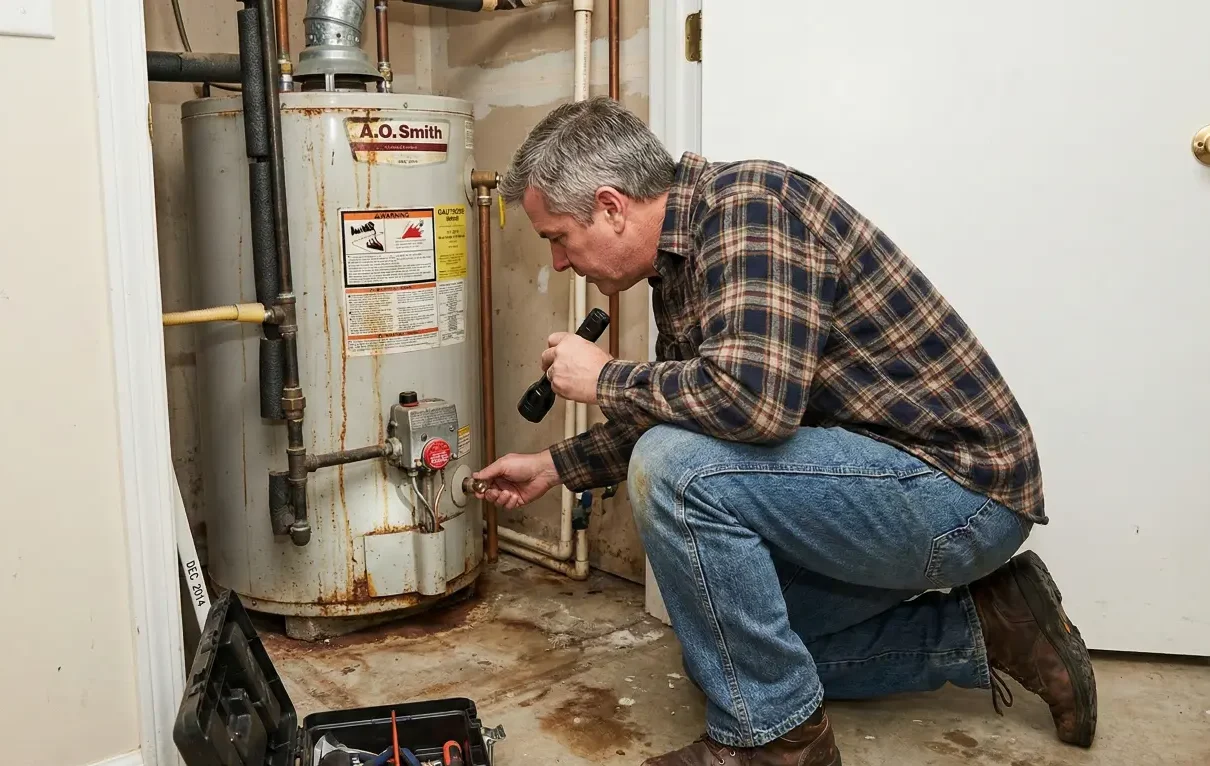
You have to decide if you repair or replace your water heater.
The real decision: fixing a part vs betting on the tank
Most water heater “repairs” are component-level fixes. That means something attached to (or controlling) the tank is causing a symptom: hot water isn’t hot enough, recovery is slow, you’re hearing noises, or there’s a small drip at a connection. In these cases, the tank may still be fine—and a targeted repair can restore performance.
Replacement solves a different problem: tank-level risk. When the tank body itself is compromised, the issue isn’t a single part you can swap. It’s the vessel that holds hot water under pressure. At 10+ years old, that matters because a unit can move from “annoying symptoms” to “failure with water damage” faster than most homeowners expect.
A practical way to frame your decision is this:
- Age sets the context. At 10+ years, you want to be more cautious about throwing money at repeated fixes.
- Symptoms tell you what category you’re in. Some symptoms lean repair. Others lean replacement.
- Safety signals override everything. If you have a suspected gas issue, active leaking, or something that looks dangerous, your next step is immediate inspection—not comparison shopping.
The next section is a quick triage that helps you avoid the most common mistake: assuming every leak means replacement or assuming every symptom can be fixed cheaply.
Start here: 5-minute triage to avoid the wrong call
You don’t need to be a plumber to collect the right clues. You just need to be specific about what you’re seeing. Here’s a short triage you can do in a few minutes to reduce guesswork.
First, look at the area around the water heater and answer three questions.
1) Where is any moisture actually coming from?
Moisture near the heater can come from a few places that mean very different things:
- A drip at a connection (pipes, fittings, valves).
- A slow weep at a valve (including the drain valve).
- Condensation or water running down from above.
- Water appearing at or near the base of the tank.
If you can identify the exact location, you’re already ahead of most troubleshooting.
2) Are there any “stop and call” safety alarms?
If any of the following are present, don’t try to “monitor it for a week”:
- A gas odor near a gas water heater.
- Scorching, charring, or unusually hot surfaces.
- Active leaking that’s spreading.
- No hot water combined with unusual behavior you can’t explain.
This isn’t about panic. It’s about treating safety signals as a priority.
3) What changed—and how fast?
Make a quick mental note of timeline:
- Did hot water performance decline over months, or did it change overnight?
- Did you notice the first drip today, or has there been occasional dampness for weeks?
- Did the popping noise start after you adjusted settings or after a period of heavy use?
That timeline helps a technician diagnose the difference between a developing issue and a sudden failure.
If you can, take a couple of photos: the overall unit, the suspected leak location, and any corrosion or staining. You’re not trying to prove anything. You’re trying to capture what you see while it’s happening.
When a repair is usually reasonable
A 10+ year-old water heater isn’t automatically “done.” Plenty of homeowners make the right call by repairing a specific, diagnosable issue—especially when the symptom points to a part or an external factor rather than the tank itself.
The key is to keep repairs in the “targeted, high-confidence” zone: you’re fixing a known cause and restoring predictable function.
“Not hot enough” or inconsistent hot water
If your water heater is producing hot water but it’s not hot enough, runs out too fast, or fluctuates, that can be repairable. What matters is whether the issue looks like a control/performance problem versus a tank integrity problem.
Here are repair-leaning signals:
- Hot water is present, but recovery is slow (it takes longer to get a second shower).
- Temperature fluctuates or seems inconsistent from day to day.
- The issue is annoying but not accompanied by leaking or rust-colored water.
Verification steps that help:
- Note whether the problem is constant or only during high demand (back-to-back showers, laundry, dishwasher).
- If you’ve adjusted the temperature setting, be cautious. A higher setting can mask a problem temporarily and can introduce safety risks. It’s better to diagnose than to “solve” by turning the dial up.
- Track when it happens. For example: “Hot water is fine in the morning, weak at night,” or “It’s always lukewarm.”
This category often falls into the “water heater not hot enough repair or replace” searches because homeowners assume the tank is failing. Sometimes it is, but often it’s a serviceable performance issue—especially if there are no red flags.
Minor leaks at connections/valves
Not every leak means the water heater is failing. A drip at a connection or valve can be the plumbing around the unit rather than the tank.
Repair-leaning signs:
- Moisture is clearly at a fitting, pipe connection, or valve—not emerging from the tank body.
- The leak is small and localized (not pooling from under the center of the tank).
- There’s no significant corrosion around the tank jacket or base.
How to verify what you’re seeing:
- Look for a trail of water. Sometimes water runs along a pipe and drips at a low point, making it look like it’s coming from the tank.
- Check above the heater as well. A slow drip from an overhead line can travel down the unit.
- If the area is wet, dry it and check again later. The goal is not to “monitor forever,” but to confirm whether it reappears and exactly where.
If the moisture is coming from a fitting, that’s often a repair discussion. If it’s coming from the bottom of the tank, that’s a different category entirely (we’ll cover that soon).
Popping/rumbling noises
Popping, rumbling, or crackling noises can be alarming. People often search “water heater popping noise what to do” because it sounds like something is about to explode. In many cases, noises are linked to buildup inside the tank, but the sound alone doesn’t tell you everything.
Repair-leaning signs:
- The heater is otherwise functioning (you still have hot water).
- There’s no leak at the base of the tank.
- The noise is intermittent and tends to happen during heat-up cycles.
Verification steps that help:
- Note when the sound happens: at the start of heating, throughout heating, or randomly.
- Describe the sound: sharp popping vs deep rumbling. (A technician can interpret this better with context.)
- Don’t assume the noise is harmless. Use it as a reason to schedule a diagnosis, especially on older units.
The goal here is to avoid extremes: don’t ignore new noises on a 10+ year unit, but don’t assume “replace immediately” just because you hear popping.
If you’re leaning toward repair after these checks, a focused service visit is usually the smartest next step. Ask for diagnosis-first: identify the cause, confirm the condition of the tank, then decide.
Repair red flags that usually push you to replacement
This is the part most homeowners want straightforward: “Tell me the signs my water heater is failing.” The safest answer is conditional, because the right choice depends on what’s actually happening. But there are clear red flags that often point to replacement—especially on a 10+ year-old unit.
Leaking from the bottom of the tank
If you’re searching “water heater leaking from bottom replace,” you’re likely seeing moisture at or under the base. This is the most important distinction in the entire guide.
Why it’s different: a leak at the bottom area can indicate the tank itself is compromised. That’s not a durable “part swap” fix. It’s often a sign the vessel is no longer reliable.
How to verify before you commit:
- Confirm it’s not a fitting or valve dripping down and pooling at the base.
- Look for water emerging from under the tank rather than from the side or a connection.
- Pay attention to frequency: is it constant, or does it appear after heavy hot water use?
If water is consistently appearing from under the tank, replacement becomes a more predictable path—because the primary risk isn’t comfort, it’s water damage.
Rust-colored water or visible corrosion near the tank
Rusty or brownish hot water is one of the most confusing symptoms. It can be connected to corrosion somewhere in the system, and the tank can be one possible source—especially as units age. The key is not to self-diagnose the exact cause but to treat it as a sign worth evaluating.
Replacement-leaning signs:
- Rust-colored water is new and recurring (not a one-time event after sitting unused).
- You see visible corrosion around tank fittings or areas near the jacket/base.
- The issue appears primarily on hot water and not cold.
Verification steps that help:
- Note whether discoloration is only on hot water taps.
- Take a photo if you can safely show what you mean by “rust-colored.”
- Pair this symptom with others. Rusty water plus dampness at the base is a stronger signal than rusty water alone.
This is a good example of where cautious wording matters. Rust-colored water can point to corrosion somewhere in the system; a plumber can confirm whether the tank is the source.
Recurring failures / repeated service calls
Even if each repair was legitimate, a pattern of recurring issues is itself a data point. On a 10+ year-old unit, repeated failures can indicate you’re entering the stage where fixes become less predictable.
Replacement-leaning signals:
- You’ve had multiple service calls in a short period for different symptoms.
- The unit seems to “work” after repair and then develops a new issue soon after.
- Your household is adjusting routines around unreliable hot water.
The decision here isn’t moral. It’s practical: if repairs are becoming frequent, replacement may be the more predictable path—especially as the unit ages.
The contrarian moment: the cheapest quote isn’t always the cheapest outcome
If you’re deciding between repair and replacement, you’ll hear two types of advice that can both be wrong in the wrong context.
One is: “Always replace at 10 years.” That can lead to unnecessary replacement when the issue is external or isolated.
The other is: “Just replace the part—it’s cheaper.” That can be a false economy if the real risk is the tank itself.
Here’s the contrarian truth: a low-cost repair is only “cheap” if it reliably returns you to stable operation. If the unit is aging and the symptom suggests tank-level risk, the cheapest repair can turn into the most expensive path because it delays the inevitable until the worst possible moment—when a leak damages flooring or walls.
At the same time, replacement isn’t automatically the smart move just because a unit is old. If the moisture is from a fitting, or performance issues point to a serviceable component, replacing the entire unit may solve a problem you didn’t actually have.
This is why verification beats rules. Your goal is to reduce uncertainty, not to follow a number on a calendar.
Common homeowner mistakes that make the problem worse
When a water heater starts acting up, it’s natural to try quick fixes. A few common moves can either introduce risk or muddy the diagnosis.
Turning the temperature too high as a “fix.”
If hot water is weak, turning up the temperature can feel like an immediate solution. But raising temperature can create safety risks and can mask an underlying problem that needs attention. It’s better to diagnose the cause than to force the system to compensate.
Ignoring dampness around the base because it’s “small.”
Small wet spots are easy to dismiss—until they aren’t. Dampness near the base is worth verifying quickly, especially on an older unit, because tank-level leaks can worsen.
Waiting until the unit fails completely before planning replacement logistics.
If you’re already seeing red flags, waiting for total failure can turn a manageable replacement into an emergency. Planning ahead can reduce disruption and help you make better decisions under less pressure.
DIY actions that complicate diagnosis.
Some DIY steps can create confusion: altering settings repeatedly, draining without knowing what you’re looking for, or “fixing” leaks temporarily without identifying the source. The best homeowner contribution is careful observation: where, when, and how symptoms show up.
Proof posture: how to verify what you’re seeing (without guessing)
The strongest decision-making is based on specific observations. If you call for service—or even if you’re just deciding whether it’s worth calling—these are the details that help the most.
Photos and observations that speed up diagnosis:
- A wide photo of the unit and surrounding area.
- A close photo of the suspected leak location.
- Any corrosion or staining you notice near connections or the base.
- If safe, a photo of the unit’s label or identifying information (TBD if you want to include exact label-reading guidance).
What to check for safely:
- Is moisture at a connection, or is it emerging from under the tank?
- Is there visible corrosion near fittings or at the base?
- Does the problem appear only during heavy use, or even when demand is low?
What to have ready for a service call:
- Unit type (gas or electric) and approximate age context (“It’s at least 10 years old”).
- Symptoms and timeline: when it started, how often it happens, whether it’s getting worse.
- Any steps you’ve already tried (temperature adjustments, reset, etc.).
- Household impact: “Runs out fast,” “lukewarm,” “inconsistent,” “noise during heat-up.”
If you want to make this process even easier, focus on the single most useful piece of information: exactly where the symptom is happening—where the leak originates, when the noise starts, which faucets show discoloration, and how quickly hot water declines.
Next steps: choose the low-friction path based on your situation
Once you’ve done the triage, you can choose a path that matches your situation—without forcing a replacement decision upfront.
If your symptoms are repair-leaning, you want a diagnosis-first visit. If your symptoms are replacement-leaning, you want confirmation and a plan that prevents a messy failure.
If your water heater is 10+ years old and symptoms just started, the fastest way to avoid the wrong spend is a clear diagnosis. We can confirm whether you’re looking at a repairable component issue—or signs the tank itself is failing. Book an appointment with Daniel’s Plumbing Services so you can decide with confidence (and avoid a surprise leak).
If you already have clear replacement-leaning red flags, it can also help to discuss replacement options in a grounded way—tank versus tankless—based on your home and expectations, not general trends.
FAQ
1) My water heater is leaking from the bottom—does that automatically mean replacement?
Not automatically, but it’s a strong red flag—especially on a 10+ year-old unit. The key is verifying where the water originates. If a connection or valve is dripping down and pooling at the base, a repair may be possible. If water is consistently emerging from under the tank, it can indicate the tank itself is compromised and replacement is often the more predictable path.
2) If my water heater isn’t hot enough, is it usually repairable?
Often it can be, depending on what’s causing the symptom. If you still have hot water but it’s inconsistent, runs out quickly, or takes longer to recover, the issue may be related to serviceable components or performance factors rather than the tank. The safest approach is diagnosis-first: confirm the cause and check the overall tank condition before deciding.
3) What does a popping or rumbling water heater sound mean?
Popping or rumbling often shows up during heating cycles and can be associated with buildup inside the tank, but the sound alone doesn’t confirm a single cause. Treat new noises as a reason to inspect and diagnose—especially on an older unit—while also looking for other red flags like dampness at the base or changes in water color.
4) Why is my hot water rusty or brown—should I replace the water heater?
Rusty-looking water can point to corrosion somewhere in the system, and the water heater can be one possible source as units age. It’s more concerning if the discoloration is recurring, shows primarily on hot water (not cold), and appears alongside visible corrosion or moisture near the heater. A plumber can confirm whether the tank is the source before you commit to replacement.
5) How do I tell how old my water heater is?
Many water heaters have a label with identifying information that can help determine age, but exact label-reading steps vary by manufacturer. If you’re unsure, take a photo of the label and share it during a service visit so the age context can be confirmed accurately. If the unit is known to be 10+ years old, that alone is enough to use this guide’s decision logic.
6) Is it worth repairing a water heater that’s over 10 years old?
It can be—when the issue is clearly component-level and the tank shows no replacement-leaning red flags. A targeted repair can make sense if it restores stable performance and the symptom doesn’t indicate tank compromise. If problems are recurring or you’re seeing tank-level signals (like consistent moisture emerging from under the tank), replacement may be the more predictable and less disruptive choice.
If your water heater is 10+ years old and symptoms just started, the fastest way to avoid the wrong spend is a clear diagnosis.
We can confirm whether you’re looking at a repairable component issue—or signs the tank itself is failing.
Book an appointment with Daniel’s Plumbing Services so you can decide with confidence (and avoid a surprise leak).
RELATED LINK: